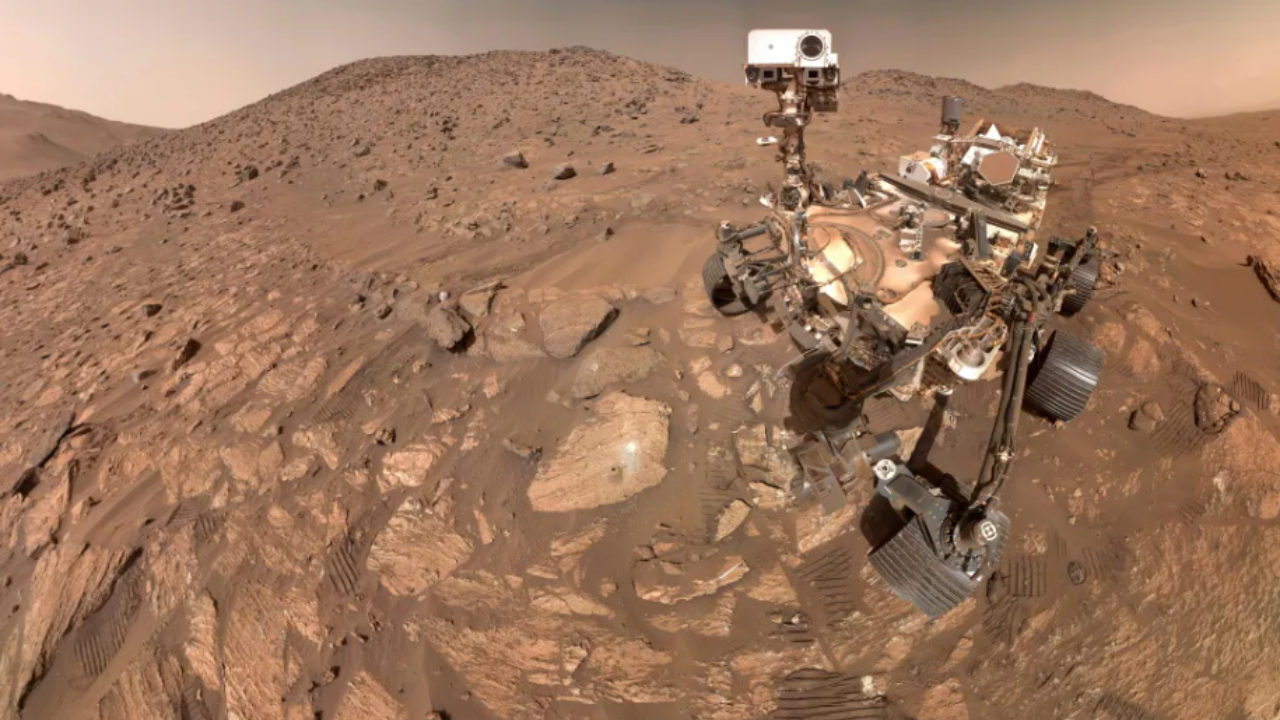
©(NASA via AP, file)
Pre-reading Questions:
I will read each question. Then, please answer them.
- What comes to mind when you imagine the weather on another planet?
- What kind of natural sounds around you do you find the most interesting or surprising?
Vocabulary:
I will read the words, meanings, and sample sentences. Then, repeat after me.
- discharge /dis-CHAHRJ/
[noun] – the release of electricity, energy, or another substance
Scientists observed weak discharges of energy near the volcano’s opening. - crackling /KRAK-ling/
[adjective] – a series of small, sharp sounds
We heard a faint crackling from the old radio during the storm. - mast /mast/
[noun] – a tall pole on a vehicle or structure that supports equipment
A weather station uses a tall mast to support its wind sensors. - absorb /ab-ZAWRB/
[verb] – to take in or soak up something such as light, liquid, or energy
The dark clouds quickly absorbed the sunlight, making the sky look dim. - detailed /dih-TEYLD/
[adjective] – showing many small facts or parts; including a lot of information
The report gave a detailed picture of the city’s traffic problems.
Article Reading:
Please read the whole article. Then, I will check your pronunciation and intonation.
Scientists reported new evidence of small electrical discharges on Mars after examining wind recordings from NASA’s Perseverance rover. The signals, described as “mini lightning,” were identified when the rover’s microphone captured crackling sounds during dust storms and dust devils. A French-led research team recorded 55 events over two Martian years and explained that most incidents occurred on the windiest days close to the rover’s mast. The findings indicated a pattern of electrical activity that had been suspected on Mars for many years. Experts stated that the discovery is important because the planet’s thin, carbon dioxide–rich atmosphere and constant dust movement create conditions that could support electrical buildup.
Further study showed how the discharges formed and why they were difficult to confirm. Acoustic and electric data revealed that dust devils produced short bursts lasting only a few seconds, while larger storms created discharges that continued for up to 30 minutes. Because Mars’ atmosphere absorbs sound, the signals were weak and required detailed analysis before being accepted. An independent researcher noted that the evidence was encouraging, although full confirmation still depended on future instruments designed to observe lightning directly. Scientists said the discovery may influence mission planning because frequent static-like discharges could interfere with sensitive equipment. Perseverance has also supplied other audio information that expands understanding of Martian surface conditions. NASA is continuing to examine safe and cost-efficient plans for returning the rover’s rock samples to Earth.
Further study showed how the discharges formed and why they were difficult to confirm. Acoustic and electric data revealed that dust devils produced short bursts lasting only a few seconds, while larger storms created discharges that continued for up to 30 minutes. Because Mars’ atmosphere absorbs sound, the signals were weak and required detailed analysis before being accepted. An independent researcher noted that the evidence was encouraging, although full confirmation still depended on future instruments designed to observe lightning directly. Scientists said the discovery may influence mission planning because frequent static-like discharges could interfere with sensitive equipment. Perseverance has also supplied other audio information that expands understanding of Martian surface conditions. NASA is continuing to examine safe and cost-efficient plans for returning the rover’s rock samples to Earth.
Comprehension Questions:
I will read each question. Then, please answer them based on the article.
- What did scientists find when they examined wind recordings from the Perseverance rover?
- What did the rover’s microphone capture during dust storms and dust devils?
- How many electrical events did the French-led team record over two Martian years?
- Why did experts say the discovery is important for understanding Mars?
- Why were the signals weak and difficult to confirm?
Discussion Questions:
I will read each question. Then, please answer them.
- Have you ever heard strange sounds during a strong wind or storm? If so, what did the sound remind you of? If not, what kind of sound do you think a storm would make?
- Have you ever seen lightning or small electrical sparks before? If so, where were you, and how did you feel? If not, when do you think you might see lightning in your area?
- Do you agree that studying strange sounds on other planets is important for science?
- Why do you think it is helpful for scientists to know about electrical discharges on Mars before sending more equipment there?
- Why do you think it is important for countries to explore space together?