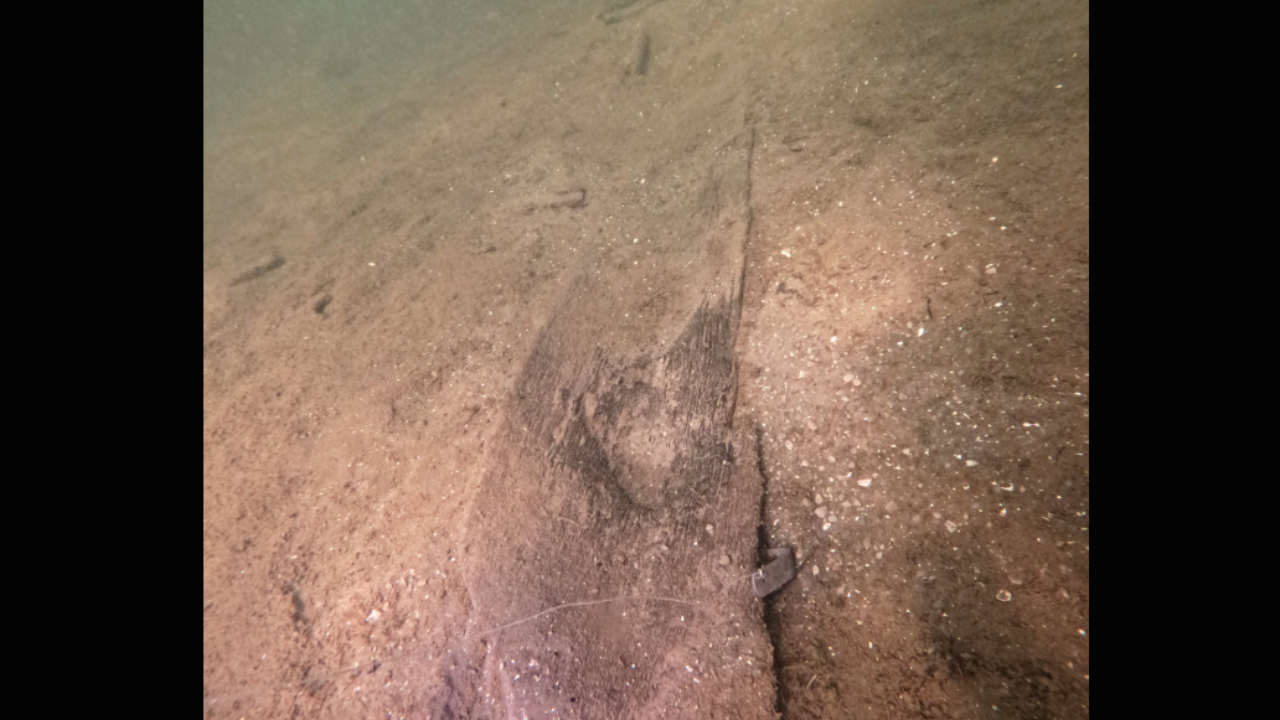
©Tamara Thomsen/Wisconsin Historical Society via AP
Vocabulary:
I will read the words, meanings, and sample sentences. Then, repeat after me.
- salient /SEY-lee-uhnt/
[adjective] – very important or noticeable
The report showed a salient change in climate data. - adjacent /uh-JEY-suhnt/
[adjective] – very near or next to something
The market stands adjacent to the main road. - prolonged /pruh-LAWNGD/
[adjective] – continuing for a long time
The team faced prolonged delays during testing. - discern /dih-SURN/
[verb] – to recognize something that is not clear
Scientists could discern faint marks on the stone. - intermittent /in-ter-MIT-nt/
[adjective] – stopping and starting repeatedly
The area experienced intermittent rainfall yesterday.
Article Reading:
Please read the whole article. Then, I will check your pronunciation and intonation.
Archaeologists reported the discovery of 16 ancient canoes in Lake Mendota, Madison, after new mapping confirmed their presence near former Indigenous trails. The announcement was released this week by the Wisconsin Historical Society, which said the findings form a salient record of travel patterns used thousands of years ago. The site lies adjacent to historic routes that once linked communities, indicating that the canoes served as shared transportation stored for public use. Radiocarbon testing shows that the vessels range from 1,200 to 5,200 years old, making the oldest canoe one of the earliest known examples in eastern North America.
Investigators explained that lake levels in the region remained shallow during a prolonged drought that lasted from roughly 7,500 years ago to 1000 B.C. This condition likely created convenient landing spaces where travelers could bury canoes in sediment to prevent drying or freezing. Specialists were able to discern layered remains, with older canoes positioned beneath younger ones, suggesting repeated activity through various eras. Work conducted by state archaeologists and tribal preservation officers also documented connections to areas leading toward Lake Wingra, a site recognized for cultural significance among Native nations. The discoveries emerged through intermittent survey dives and continue to provide clues about long-term settlement, movement, and water-based technology in the region.
Investigators explained that lake levels in the region remained shallow during a prolonged drought that lasted from roughly 7,500 years ago to 1000 B.C. This condition likely created convenient landing spaces where travelers could bury canoes in sediment to prevent drying or freezing. Specialists were able to discern layered remains, with older canoes positioned beneath younger ones, suggesting repeated activity through various eras. Work conducted by state archaeologists and tribal preservation officers also documented connections to areas leading toward Lake Wingra, a site recognized for cultural significance among Native nations. The discoveries emerged through intermittent survey dives and continue to provide clues about long-term settlement, movement, and water-based technology in the region.
Discussion Questions:
I will read each question. Then, please answer them.
- Have ancient objects ever been found in your area? If so, what object? If not, what object would surprise residents?
- Have you visited a historical site connected to early communities? If so, what did you observe? If not, what site would you want to visit?
- Do you agree that protecting underwater heritage is essential for cultural knowledge?
- How can modern communities balance scientific study with Indigenous cultural protocols?
- How should governments and Indigenous communities work together to protect underwater heritage sites while ensuring respectful access for scientific study?
Summarization:
Please summarize the whole article using your own words and expressions. You will have one minute to prepare before you answer.
Describe:
Please explain the definition of each word listed below based on your understanding. You can provide example sentences if needed.
- discovery
- presence
- remain
- cultural
- survey