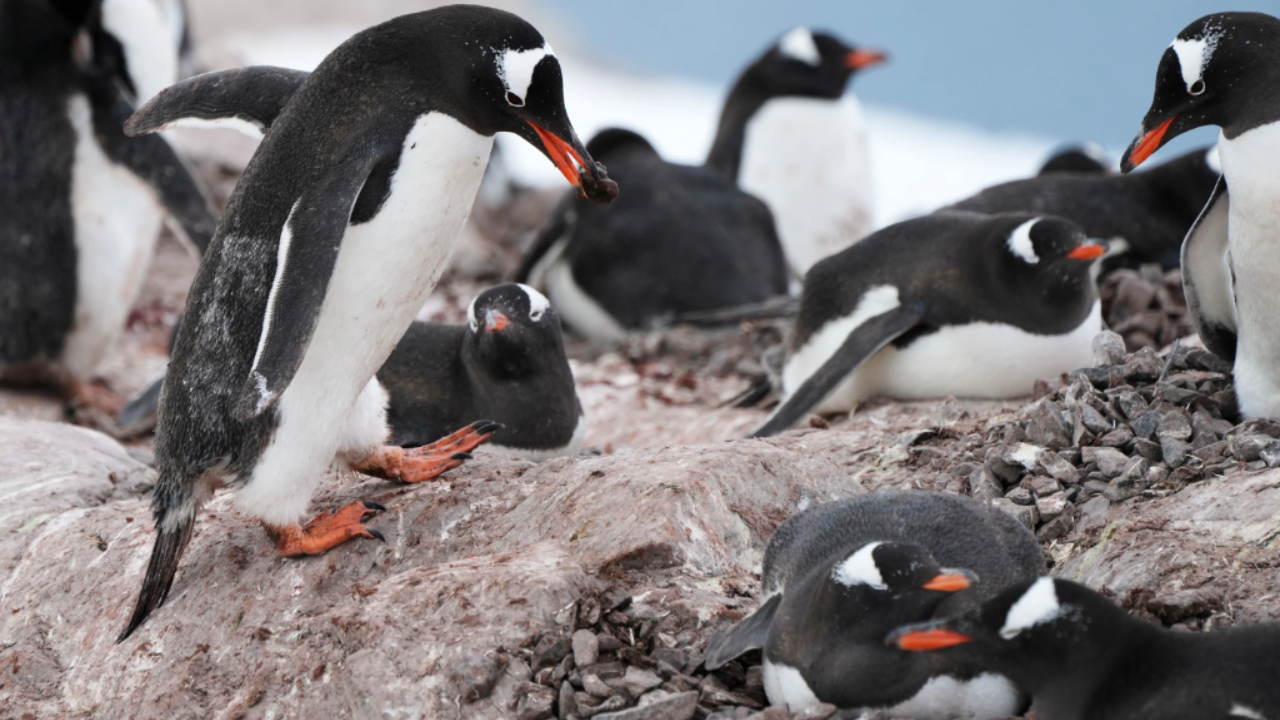
©(AP Photo/Mark Baker)
Pre-reading Questions:
I will read each question. Then, please answer them.
講師がそれぞれの質問を読むので答えましょう。
- Do you think living in a very cold place would be difficult?
- Do you think studying nature can help protect animals?
Vocabulary:
I will read the words, meanings, and sample sentences. Then, repeat after me.
単語、意味、例文を読みます。講師に続いて音読しましょう。
- absorb /ab-ZAWRB/
[verb] – to take in or soak up something
The forest can absorb large amounts of carbon dioxide from the air. - atmosphere /AT-muhs-feer/
[noun] – the layer of gases surrounding the Earth
Smoke from factories can affect the atmosphere over large cities. - pattern /PAT-ern/
[noun] – a regular or repeated way something happens
Scientists studied weather patterns to understand changes in rainfall. - influence /IN-floo-uhns/
[verb] – to have an effect on something
Weather conditions can influence travel plans. - future /FYOO-cher/
[noun] – the time that comes after the present
The company is planning new projects for the future.
Article Reading:
Please read the whole article. Then, I will check your pronunciation and intonation.
記事を音読しましょう。講師はあなたの発音とイントネーションを確認します。
The Antarctic Peninsula is receiving more attention from scientists because the environment is changing quickly. The area is located in the northern part of Antarctica and is surrounded by the Southern Ocean. It is known for strong waves, large ice sheets, and animals that can live in very cold conditions. In recent years, the region has warmed faster than many other places. Scientists say this warming is mainly caused by the burning of oil, gas, and coal. The nearby ocean is important because it absorbs carbon dioxide from the atmosphere, which affects the Earth’s climate. Changes in this area help scientists understand global warming.Studies show that higher temperatures are causing ice to melt and wildlife patterns to change. Satellite records from 2002 to 2020 show that Antarctica lost about 149 billion metric tons of ice each year. Experts say ice loss will continue if greenhouse gas emissions are not reduced. Gentoo penguins are moving farther south because open water and ice-free land make nesting easier. Adelie penguins are more affected because they depend on sea ice for resting and finding food. These changes influence animal life, ocean systems, and sea levels, which may affect many parts of the world in the future.
True or False:
Read the sentences and identify if they are true or false based on the article.
文章を読んで、記事に基づいて正誤を答えましょう。
- The Antarctic Peninsula is receiving more attention from scientists because the environment is changing quickly.
- The Antarctic Peninsula is located in the southern part of Antarctica.
- The region is known for calm seas and warm weather.
- The region has warmed faster than many other places in recent years.
- Satellite records show that Antarctica gained ice between 2002 and 2020.
Fill in the Blanks:
Choose the correct word from the table, then fill in the blanks.
適切な言葉を選んで空欄を埋めましょう。
| absorb | atmosphere | pattern | influence | future |
- Education plays an important role in the ______ of society.
- Healthy soil helps ______ gases and particles from the environment.
- Volcanic activity releases particles into the _______ over wide areas.
- Experts reported a ______ of rising energy use in large cities.
- Good sleep habits ______ student performance at school.