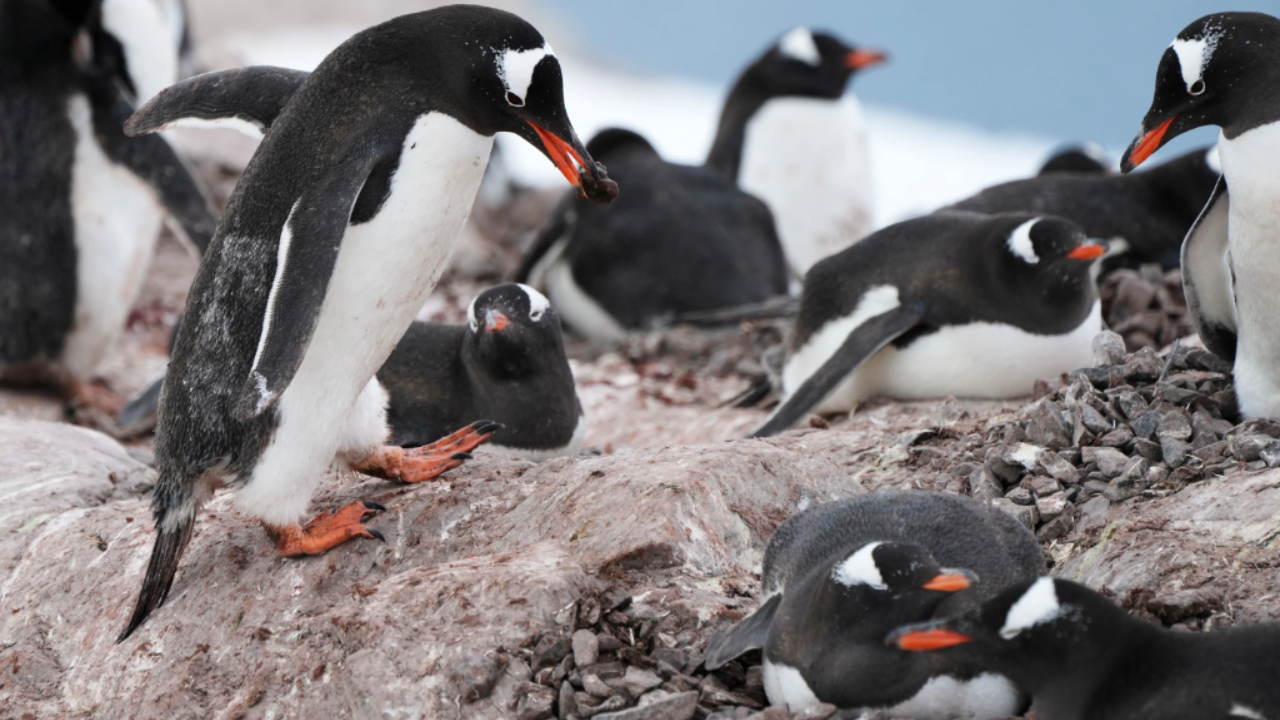
©(AP Photo/Mark Baker)
Pre-reading Questions:
I will read each question. Then, please answer them.
- When you hear the word “Antarctica,” what images or feelings come to mind?
- How do you think animals survive in places with very cold weather?
Vocabulary:
I will read the words, meanings, and sample sentences. Then, repeat after me.
- rapid /RAP-id/
[adjective] – happening very quickly
The city experienced rapid population growth after new factories opened. - glacier /GLEY-sher/
[noun] – a large, slow-moving mass of ice
The glacier moved slowly down the mountain over many years. - impact /IM-pakt/
[noun] – a strong effect or influence
The new law had a major impact on public transportation. - reduction /ri-DUHK-shuhn/
[noun] – a decrease in size, amount, or level
The company announced a reduction in energy use to save costs. - biodiversity /bahy-oh-di-VUR-si-tee/
[noun] – the variety of living plants and animals in one area
The park protects biodiversity by limiting construction.
Article Reading:
Please read the whole article. Then, I will check your pronunciation and intonation.
The Antarctic Peninsula has become an important focus of scientific research due to rapid environmental changes caused by global warming. The region is located at the northern edge of Antarctica and is surrounded by the Southern Ocean. It is known for strong seas, large glaciers, and wildlife that can survive extreme conditions. In recent decades, global temperatures have risen mainly because of the burning of oil, gas, and coal. Scientists report that warming in the Antarctic Peninsula has occurred faster than in many other parts of the world. The surrounding ocean plays a major role in the global climate system because it absorbs large amounts of carbon dioxide produced by human activity. As a result, changes in this region provide early signs of wider climate impacts.
Scientific studies show how rising temperatures are affecting ice levels, ocean conditions, and animal populations. Satellite data collected between 2002 and 2020 indicate that Antarctica lost an average of about 149 billion metric tons of ice each year. Researchers warn that this rate of ice loss is likely to continue without major reductions in greenhouse gas emissions. Gentoo penguins have expanded farther south because open water and ice-free ground support nesting and feeding. In contrast, Adelie penguins remain at risk because sea ice is necessary for resting and finding food. These environmental changes influence food systems, predator behavior, and ocean balance, creating long-term effects on biodiversity and global sea levels.
Scientific studies show how rising temperatures are affecting ice levels, ocean conditions, and animal populations. Satellite data collected between 2002 and 2020 indicate that Antarctica lost an average of about 149 billion metric tons of ice each year. Researchers warn that this rate of ice loss is likely to continue without major reductions in greenhouse gas emissions. Gentoo penguins have expanded farther south because open water and ice-free ground support nesting and feeding. In contrast, Adelie penguins remain at risk because sea ice is necessary for resting and finding food. These environmental changes influence food systems, predator behavior, and ocean balance, creating long-term effects on biodiversity and global sea levels.
Comprehension Questions:
I will read each question. Then, please answer them based on the article.
- Where is the Antarctic Peninsula located?
- What ocean surrounds the Antarctic Peninsula?
- What natural features is the region known for?
- What main human activity has caused global temperatures to rise?
- Why is the surrounding ocean important to the global climate system?
Discussion Questions:
I will read each question. Then, please answer them.
- Have you ever learned about climate change at school or online? If so, what did you learn about it? If not, where do you usually learn about world problems?
- Have you ever seen animals on TV or online that live in very cold places? If so, which animals did you see? If not, which cold-place animal would you like to learn about?
- Do you agree that scientists need to study Antarctica to understand climate change?
- What could happen if ice in Antarctica continues to melt in the future?
- What actions can help stop environmental problems from getting worse?