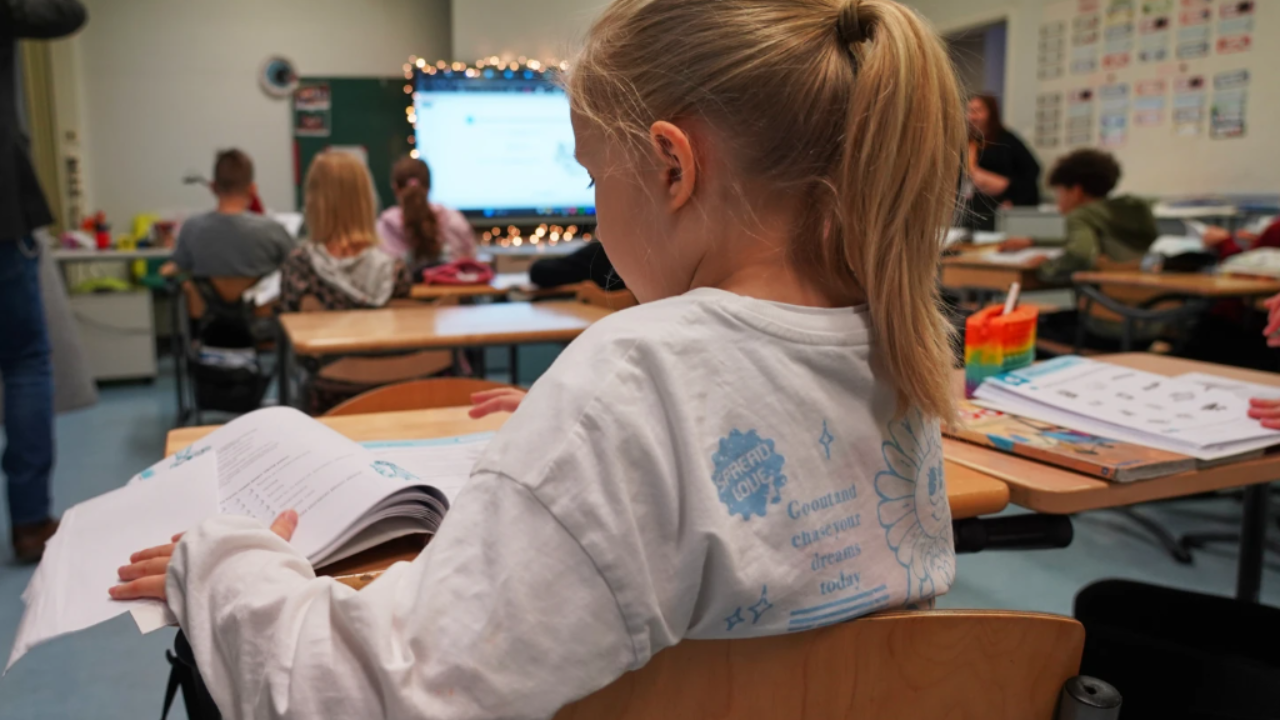
©(AP Photo/James Brooks)
Pre-reading Questions:
I will read each question. Then, please answer them.
- What kind of information do you see most often online every day?
- If you could learn one skill about news at school, what would you like to learn?
Vocabulary:
I will read the words, meanings, and sample sentences. Then, repeat after me.
- literacy /LIT-er-uh-see/
[noun] – the ability to read, understand, and use information
Digital literacy is important for students who use the internet for learning. - curriculum /kuh-RIK-yuh-luhm/
[noun] – the subjects and skills taught in a school program
The school added computer skills to the curriculum last year. - disinformation /dis-in-fer-MEY-shuhn/
[noun] – false information shared to mislead people
Disinformation online can cause confusion during emergencies. - misleading /mis-LEE-ding/
[adjective] – giving a wrong idea or impression
The advertisement was misleading and caused customer complaints. - institution /in-sti-TOO-shuhn/
[noun] – an organized group with an important role in society
The university is a major educational institution in the city.
Article Reading:
Please read the whole article. Then, I will check your pronunciation and intonation.
Finland has developed a long-term strategy to fight fake news by teaching media literacy from early childhood. Media education has been part of the national school curriculum since the 1990s, with lessons starting in preschool. The program is used nationwide, including in schools in Helsinki and other cities, and helps students understand news, advertising, and online information. Attention to the policy increased after 2022, when the war in Ukraine raised concerns about disinformation in Europe. Interest grew further after Finland joined NATO in 2023. Officials said the goal is to protect democracy and social stability by strengthening people’s ability to identify false or misleading claims. Finland has about 5.6 million people and regularly ranks first in the European Media Literacy Index.
Experts link this success to long-term education and cooperation between schools, media organizations, and public institutions. In classrooms, students learn how to check sources, compare headlines, and question images shared online. Teachers explain how emotional language and missing information can affect understanding. Recent lessons also address artificial intelligence, as AI-generated images and videos have increased online risks. Media companies support schools through programs such as Newspaper Week, which provides free access to verified news. Researchers in Helsinki warned that future AI tools may create more convincing false content, increasing risks to public trust. However, specialists said early education can reduce long-term risks by building strong critical thinking skills.
Experts link this success to long-term education and cooperation between schools, media organizations, and public institutions. In classrooms, students learn how to check sources, compare headlines, and question images shared online. Teachers explain how emotional language and missing information can affect understanding. Recent lessons also address artificial intelligence, as AI-generated images and videos have increased online risks. Media companies support schools through programs such as Newspaper Week, which provides free access to verified news. Researchers in Helsinki warned that future AI tools may create more convincing false content, increasing risks to public trust. However, specialists said early education can reduce long-term risks by building strong critical thinking skills.
Comprehension Questions:
I will read each question. Then, please answer them based on the article.
- What long-term strategy has Finland developed to fight fake news?
- When did media education become part of the national school curriculum in Finland?
- Where do media literacy lessons start in Finnish schools?
- What kinds of information does the program help students understand?
- What is the main goal of the policy, according to officials?
Discussion Questions:
I will read each question. Then, please answer them.
- Have you ever talked with friends or family about a news story? If so, what was the news about? If not, who do you usually talk to about information you see?
- Have you ever seen information online that looked false or confusing? If so, what made it look false to you? If not, what helps you trust information?
- Do you agree that students should learn how to check news at school?
- Why can AI images and videos be a problem for online information?
- How can learning from a young age help people make better choices online?