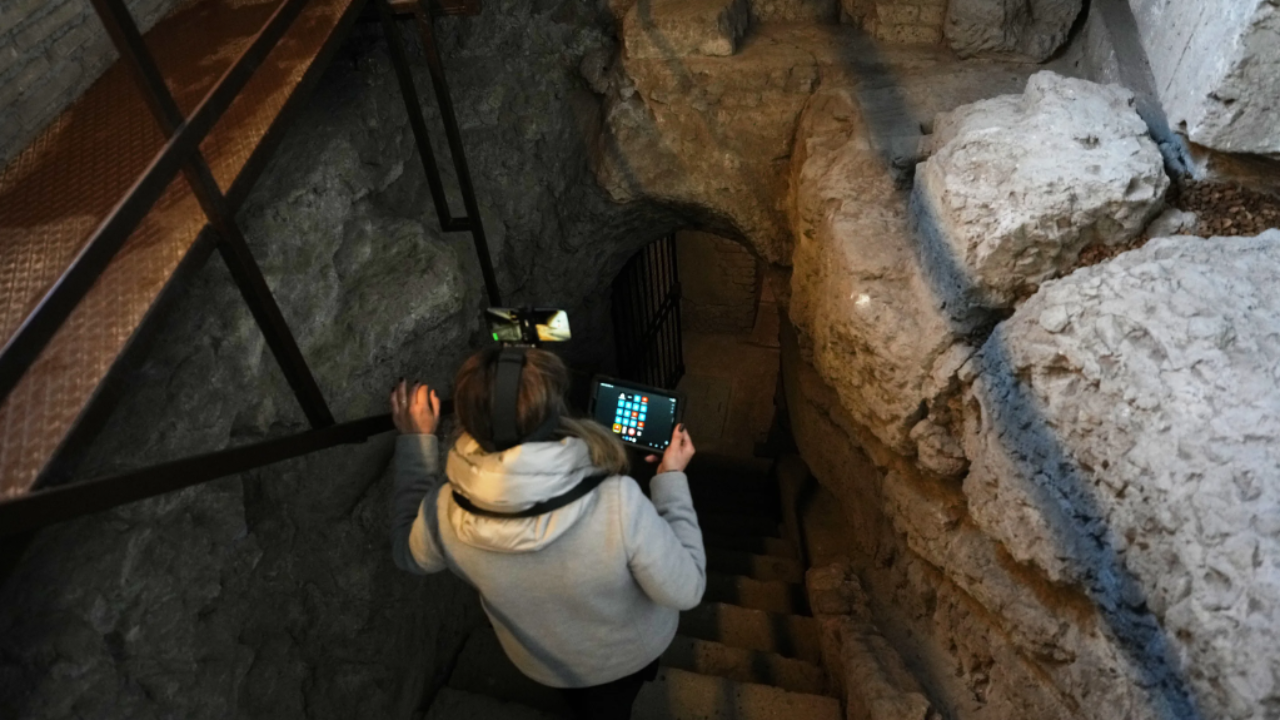
©(AP Photo/Andrew Medichini)
Pre-reading Questions:
I will read each question. Then, please answer them.
- What makes a place interesting to explore?
- Have you heard of online tours? How do you think they work?
Vocabulary:
I will read the words, meanings, and sample sentences. Then, repeat after me.
- accessible /ak-SES-uh-buhl/
[adjective] – able to be reached or used
The online class is accessible to students in different countries. - excavation /eks-kuh-VEY-shuhn/
[noun] – the act of digging to uncover something
The excavation revealed old tools under the ground. - humidity /hyoo-MID-i-tee/
[noun] – the amount of water in the air
High humidity makes hot weather feel uncomfortable. - artistic /ahr-TIS-tik/
[adjective] – related to art or creative skill
The student showed artistic talent in the school project. - landmark /LAND-mahrk/
[noun] – an important or well-known place
The tower is a landmark in the center of the city.
Article Reading:
Please read the whole article. Then, I will check your pronunciation and intonation.
One of the best-preserved ancient Roman homes on Palatine Hill is opening to the public through a new virtual program. The site, known as the House of the Griffins, will be accessible starting March 3 through livestreamed tours. The house dates back to the Roman Republic period and was discovered during excavations in the early 20th century. Palatine Hill, located near the Roman Forum and the Colosseum, was a major residential area for wealthy citizens before the Roman Empire began. The structure was later buried underground when Emperor Domitian built a palace above it in the first century A.D., a change that helped preserve the house. Archaeologists describe the site as an important example of elite Roman domestic life due to its location, decorative quality, and condition.
The tours are conducted by a guide using a wearable camera to show rooms that are difficult to access. This method allows public viewing while protecting fragile spaces. Experts involved in the project explained that limiting physical entry helps prevent damage caused by humidity and carbon dioxide. Inside, the house contains frescoes with painted marble designs and detailed floor mosaics that reflect high artistic skill. The restoration followed a carefully planned process funded by the European Union. The project is part of a broader effort to reduce overcrowding at major Roman landmarks. Officials stated that the virtual format supports education and tourism while protecting cultural heritage and encouraging interest in less-visited archaeological areas.
The tours are conducted by a guide using a wearable camera to show rooms that are difficult to access. This method allows public viewing while protecting fragile spaces. Experts involved in the project explained that limiting physical entry helps prevent damage caused by humidity and carbon dioxide. Inside, the house contains frescoes with painted marble designs and detailed floor mosaics that reflect high artistic skill. The restoration followed a carefully planned process funded by the European Union. The project is part of a broader effort to reduce overcrowding at major Roman landmarks. Officials stated that the virtual format supports education and tourism while protecting cultural heritage and encouraging interest in less-visited archaeological areas.
Comprehension Questions:
I will read each question. Then, please answer them based on the article.
- Where is Palatine Hill located near?
- Who built a palace above the house in the first century A.D.?
- How are visitors able to see the house today?
- What does the guide use to show the rooms?
- Why is physical entry limited inside the house?
Discussion Questions:
I will read each question. Then, please answer them.
- Have you ever visited an old building or historical place? If so, what did you see there? If not, what kind of old place would you like to visit?
- Have you ever watched an online tour or video of a famous place? If so, what place did you watch? If not, would you like to try an online tour? Why or why not?
- Do you agree that online tours are a good way to see old places?
- Why is it important to keep old houses safe for the future?
- How can technology help people learn about ancient life more easily than books?