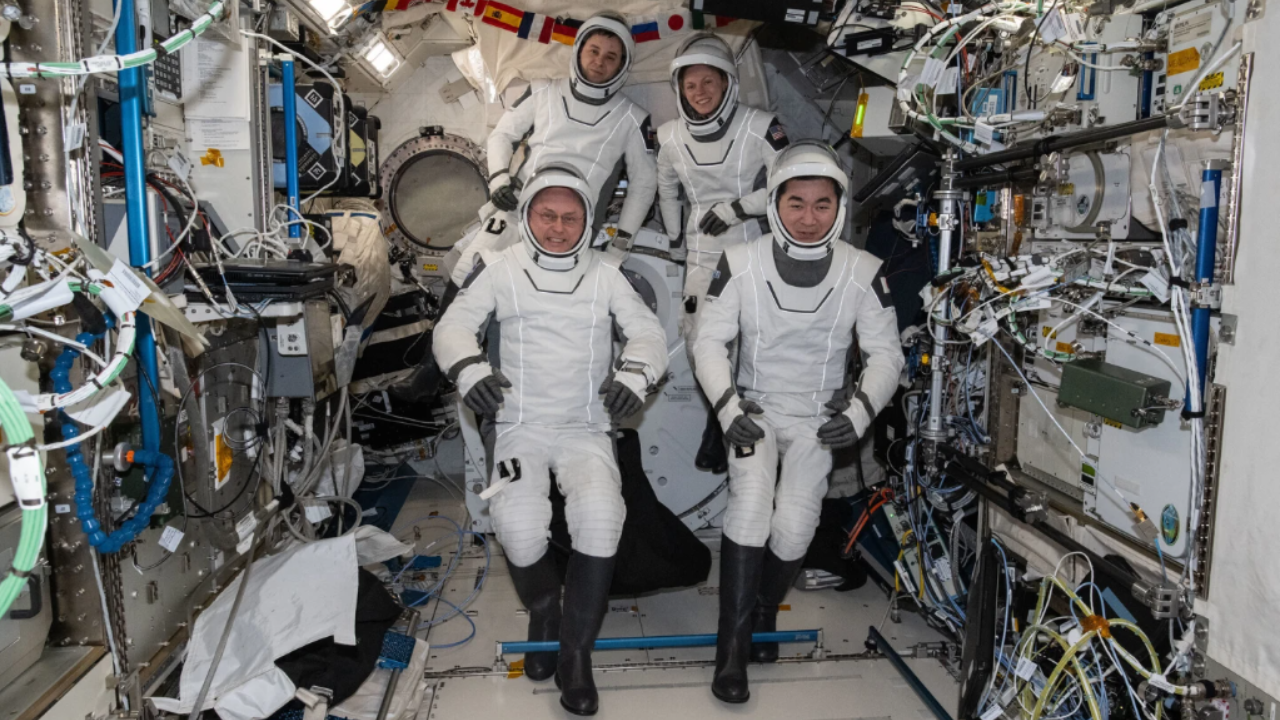
©(NASA via AP)
Pre-reading Questions:
I will read each question. Then, please answer them.
- What do you think is difficult about living in space?
- What kind of support do you think astronauts need in space?
Vocabulary:
I will read the words, meanings, and sample sentences. Then, repeat after me.
- evacuation /ih-vak-yoo-EY-shuhn/
[noun] – the act of moving people away from a dangerous place
The storm warning led to the evacuation of homes near the coast. - timeline /TAHYM-lahyn/
[noun] – a planned schedule of events
The project timeline changed after new rules were announced. - reentry /ree-EN-tree/
[noun] – the act of returning to a place
The athlete planned a reentry into competitive sports after recovery. - accurate /AK-yer-it/
[adjective] – correct and exact
The report gave accurate information about the weather. - aboard /uh-BAWRD/
[adverb] – on or inside a vehicle
All passengers are now aboard the train.
Article Reading:
Please read the whole article. Then, I will check your pronunciation and intonation.
An astronaut returned early from the International Space Station in January after medical experts decided that further evaluation was needed on Earth. The return marked the first medical evacuation in NASA human spaceflight history. The spacecraft undocked from the station and landed in the Pacific Ocean near San Diego after an overnight journey. The mission began in August and was scheduled to continue until late February, but the timeline changed after a planned spacewalk was canceled earlier in the month. NASA officials confirmed that the medical condition was stable and not linked to station operations. Further details were not released because of medical privacy rules. The decision aimed to protect astronaut health and maintain mission safety during research in low Earth orbit.
The return followed standard reentry procedures using a Crew Dragon capsule operated by SpaceX, with medical teams waiting on a recovery ship. Space medicine specialists explained that hospitals on Earth provide advanced testing tools not available in space, allowing more accurate diagnoses. The early return reduced the number of astronauts aboard the station, causing a temporary pause in spacewalks that require support from inside the station. NASA and SpaceX then prepared an earlier launch of the next crew to restore operations. Studies have suggested that medical returns from space could occur every few years, showing the need for careful planning and reliable spacecraft systems during future space missions.
The return followed standard reentry procedures using a Crew Dragon capsule operated by SpaceX, with medical teams waiting on a recovery ship. Space medicine specialists explained that hospitals on Earth provide advanced testing tools not available in space, allowing more accurate diagnoses. The early return reduced the number of astronauts aboard the station, causing a temporary pause in spacewalks that require support from inside the station. NASA and SpaceX then prepared an earlier launch of the next crew to restore operations. Studies have suggested that medical returns from space could occur every few years, showing the need for careful planning and reliable spacecraft systems during future space missions.
Comprehension Questions:
I will read each question. Then, please answer them based on the article.
- When did the astronaut return early from the International Space Station?
- Why did medical experts decide the astronaut should return to Earth?
- What made this return the first in NASA human spaceflight history?
- What did the spacecraft do before leaving the space station?
- How did NASA officials describe the astronaut’s medical condition?
Discussion Questions:
I will read each question. Then, please answer them.
- Have you ever watched or read news about astronauts? If yes, what do you find interesting? If not, where do you get science news?
- Have you ever thought about how astronauts get medical care in space? If yes, what do you think is difficult? If not, what do you want to know about medical care in space?
- Do you agree that protecting astronaut health is more important than finishing a space mission?
- What problems do you think can happen when a space mission changes suddenly?
- What do you think is the hardest part of returning to Earth after a long mission?