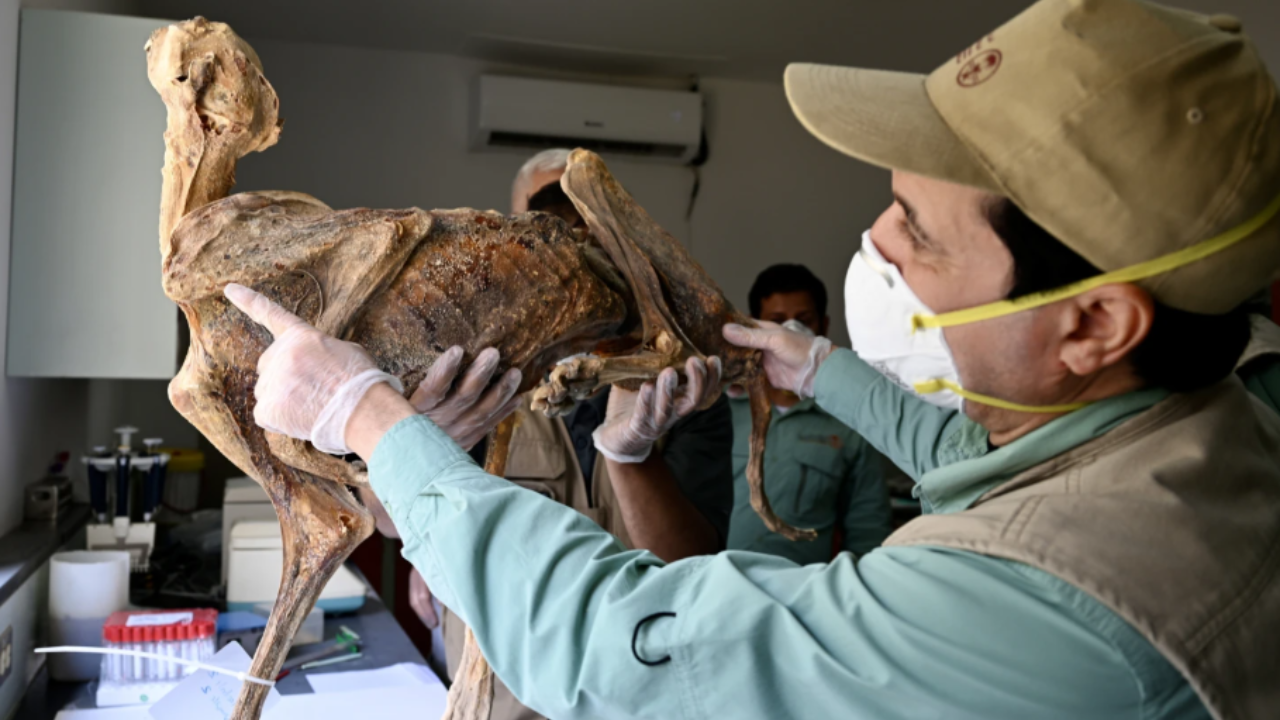
©(Ahmed Boug/Communications Earth and Environment via AP)
Vocabulary:
I will read the words, meanings, and sample sentences. Then, repeat after me.
- mummified /MUH-muh-fyd/
[adjective] – preserved by natural drying so decay is slowed
The museum displayed a mummified animal found in a frozen mountain area. - unprecedented /uhn-PRES-i-den-tid/
[adjective] – never done or known before
Scientists described the temperature increase as unprecedented for that region. - scavenger /SKAV-in-jer/
[noun] – an animal that eats dead or leftover food
The vulture is a scavenger that feeds on dead animals in the wild. - extensive /ik-STEN-siv/
[adjective] – large in size, amount, or range
The study required extensive research before results could be published. - arid /AR-id/
[adjective] – very dry with little rainfall
The arid landscape supports only a small number of plant species.
Article Reading:
Please read the whole article. Then, I will check your pronunciation and intonation.
Scientists have uncovered rare naturally mummified cheetah remains inside caves in northern Saudi Arabia, offering new evidence of the species’ historical presence in the region. The discovery occurred near the city of Arar, where researchers excavated seven mummified cheetahs and bones from at least fifty-four other individuals. Scientific dating showed the remains were between about one hundred thirty and more than one thousand eight hundred years old. This finding was described as unprecedented for the Arabian Peninsula because large mammals are rarely preserved in such complete condition. The discovery also helps explain past ecosystems, since cheetahs once ranged across Africa and parts of Asia but no longer appear in Arabia. Habitat loss, unregulated hunting, and reduced prey availability are considered major causes behind this disappearance, making the site important for understanding regional environmental change.
The cheetahs were preserved through natural mummification, a process that can occur in dry environments with stable temperatures. Researchers explained that cave conditions slowed decay and limited scavenger access, a factor considered significant for large animal remains. Modern genetic testing allowed examination of ancient DNA, producing insightful data linking the remains to modern cheetah populations from Asia and northwest Africa. This genetic connection may support future conservation planning, although such efforts would be complex due to extensive landscape change. The discovery holds substantial scientific value by combining archaeology, genetics, and wildlife research to improve understanding of long-term biodiversity patterns in arid regions for worldwide conservation research today.
The cheetahs were preserved through natural mummification, a process that can occur in dry environments with stable temperatures. Researchers explained that cave conditions slowed decay and limited scavenger access, a factor considered significant for large animal remains. Modern genetic testing allowed examination of ancient DNA, producing insightful data linking the remains to modern cheetah populations from Asia and northwest Africa. This genetic connection may support future conservation planning, although such efforts would be complex due to extensive landscape change. The discovery holds substantial scientific value by combining archaeology, genetics, and wildlife research to improve understanding of long-term biodiversity patterns in arid regions for worldwide conservation research today.
Discussion Questions:
I will read each question. Then, please answer them.
- Have you ever visited a museum or place that showed ancient animals or fossils? If so, what was the most interesting thing you learned there? If not, would you like to visit such a place in the future? Why or why not?
- Have you learned about animals that lived in your country long ago but no longer live there today? If so, what caused the animals to disappear? If not, where do you usually learn about animals from the past?
- Do you agree that studying ancient animal remains can help scientists understand environmental changes today?
- What difficulties might scientists face when using ancient DNA to support animal protection plans?
- How might human activities in the past still affect wildlife and ecosystems today?
Summarization:
Please summarize the whole article using your own words and expressions. You will have one minute to prepare before you answer.
Describe:
Please explain the definition of each word listed below based on your understanding. You can provide example sentences if needed.
- species
- discovery
- researcher
- ecosystem
- environmental