Vocabulary:
I will read the words, meanings, and sample sentences. Then, repeat after me.
- primate /PRAHY-meyt/
[noun] – a mammal with a highly developed brain, such as a monkey or ape
Scientists study the primate to better understand animal behavior. - innate /ih-NEYT/
[adjective] – existing from birth, not learned or taught
The child showed an innate ability to solve puzzles quickly. - pretense /pri-TENS/
[noun] – an act of pretending that something is true when it is not
He spoke with confidence, but it was a pretense to cover his fear. - comprehensive /kom-pri-HEN-siv/
[adjective] – including all important parts or details
Students must complete a comprehensive exam at the end of the course. - pivotal /PIV-uh-tl/
[adjective] – very important and able to influence future events
The meeting played a pivotal role in shaping company policy.
Article Reading:
Please read the whole article. Then, I will check your pronunciation and intonation.
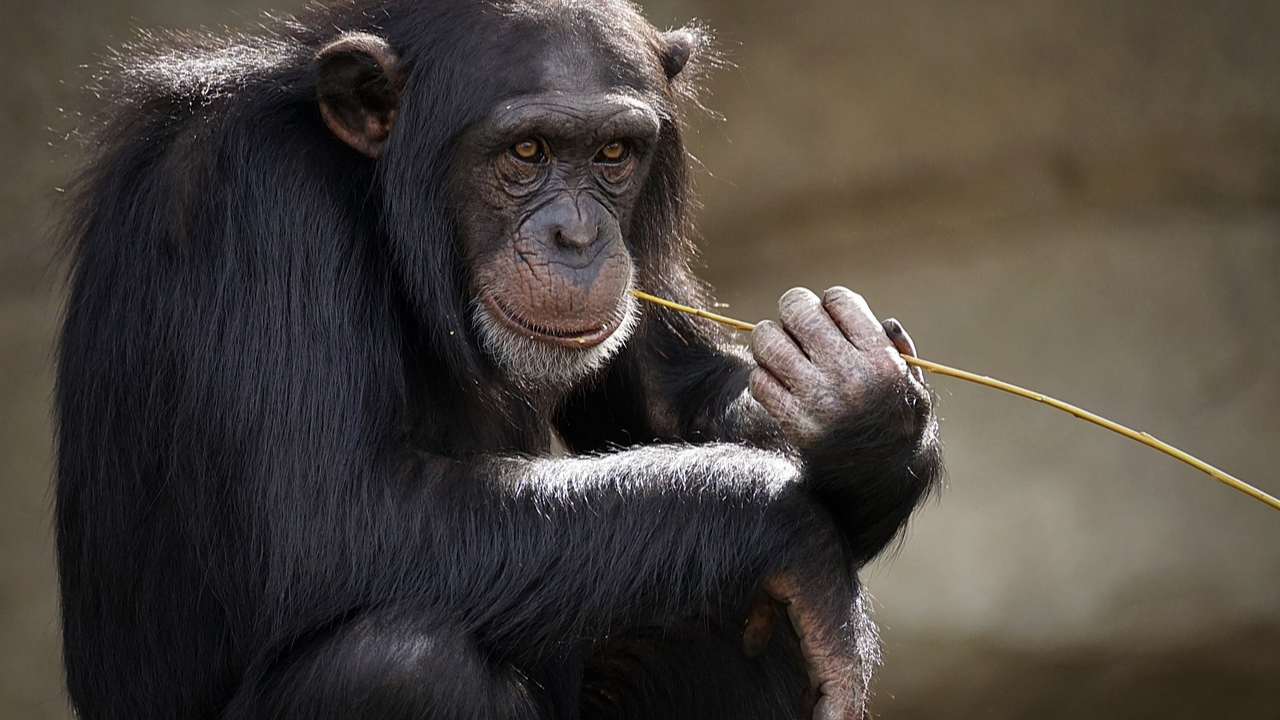
A scientific report published in the journal Science indicates that the ability to imagine is not a purely human characteristic. During a recent study, researchers from Johns Hopkins University and the University of St. Andrews observed a captive bonobo named Kanzi to see if apes could understand make-believe scenarios. This mental skill, which serves as the bedrock of human invention, involves pretending that a situation is real despite knowing it is false. While some wild chimpanzees have displayed similar behaviors with sticks, this experiment provides the first formal data regarding such mental processes in primates. The findings suggest that the capacity for creative thought might be innate to several species within the great ape family.
The investigation involved a series of social tests where scientists poured invisible liquid into containers. Kanzi successfully identified the cup that was supposed to hold the liquid in 68% of the attempts, showing an understanding of abstract concepts. To verify that the animal was not simply confused, the team offered a choice between actual juice and the fake version. The bonobo selected the real option in 80% of the cases, which proves a clear distinction between reality and pretense. However, critics like Michael Tomasello argue that more evidence is needed to confirm a comprehensive understanding of imagination. These experts believe the unique environment of a laboratory might influence such results. Regardless of these debates, the study remains a pivotal development in the field of animal psychology.
The investigation involved a series of social tests where scientists poured invisible liquid into containers. Kanzi successfully identified the cup that was supposed to hold the liquid in 68% of the attempts, showing an understanding of abstract concepts. To verify that the animal was not simply confused, the team offered a choice between actual juice and the fake version. The bonobo selected the real option in 80% of the cases, which proves a clear distinction between reality and pretense. However, critics like Michael Tomasello argue that more evidence is needed to confirm a comprehensive understanding of imagination. These experts believe the unique environment of a laboratory might influence such results. Regardless of these debates, the study remains a pivotal development in the field of animal psychology.
Discussion Questions:
I will read each question. Then, please answer them.
- Have you learned about animal behavior in science class before? If yes, what did you learn? If not, what would you like to learn about animals?
- Have you taken part in a classroom activity that used imagination? If yes, how did it help your learning? If not, what kind of activity do you think could use imagination?
- Do you agree that imagination can be studied through simple experiments?
- Why is it important for scientists to know if animals can tell the difference between real and fake?
- What problems might happen when animals are studied only in laboratories?
Summarization:
Please summarize the whole article using your own words and expressions. You will have one minute to prepare before you answer.
Describe:
Please explain the definition of each word listed below based on your understanding. You can provide example sentences if needed.
- scientific
- ability
- behavior
- experiment
- creative