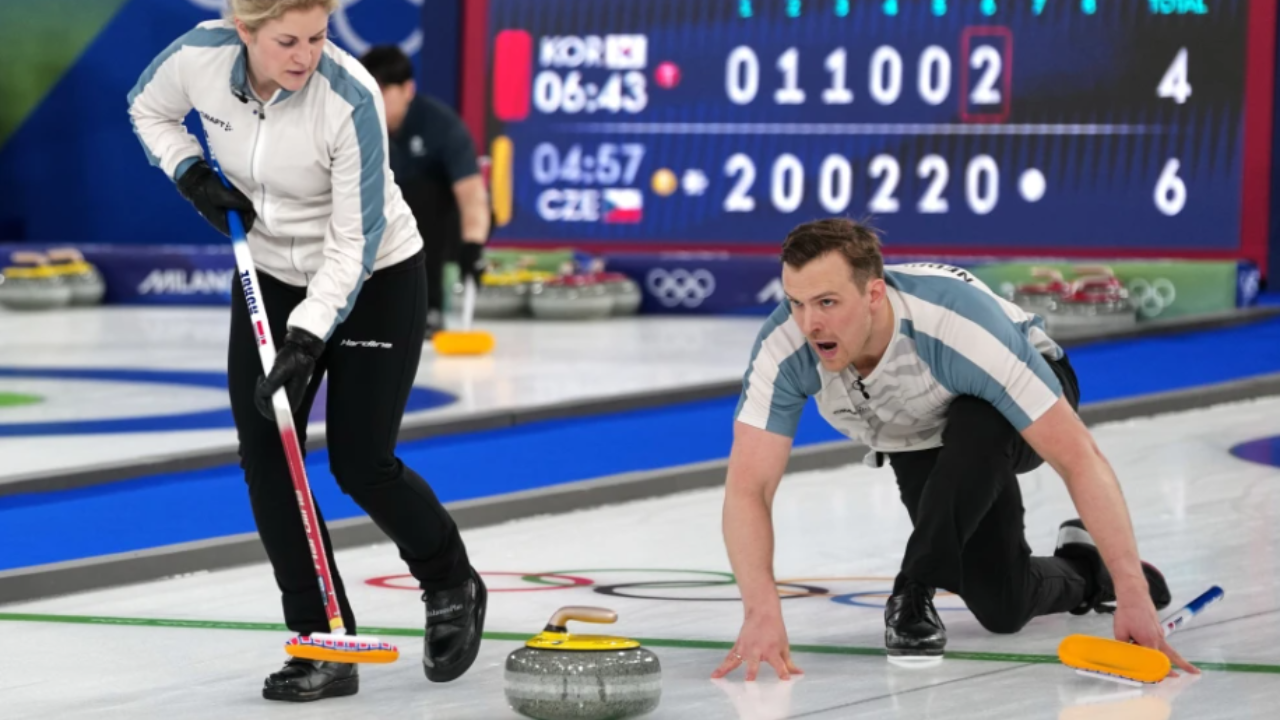
©(AP Photo/Misper Apawu)
Pre-reading Questions:
I will read each question. Then, please answer them.
- What do you think is easy about working in a team of only two people?
- What do you do when you and another person have different opinions?
Vocabulary:
I will read the words, meanings, and sample sentences. Then, repeat after me.
- intense /in-TENS/
[adjective] – very strong or high in degree
The debate became intense as the deadline approached. - tension /TEN-shuhn/
[noun] – a feeling of stress or disagreement
There was tension in the office after the sudden policy change. - constant /KON-stuhnt/
[adjective] – happening all the time or without stopping
Constant noise from traffic made it hard to concentrate. - semifinal /sem-ee-FAHYN-l/
[noun] – a match played before the final round of a competition
The team reached the semifinal after a close victory. - strategic /struh-TEE-jik/
[adjective] – relating to careful planning to achieve a goal
The teacher used a strategic approach to manage class time.
Article Reading:
Please read the whole article. Then, I will check your pronunciation and intonation.
Mixed doubles curling at the Milan Cortina Winter Games has highlighted how personal relationships can influence performance in elite sports. The event is being held at the Olympic Ice Stadium in Italy, where teams of two compete under intense pressure. Several teams include married couples or close family members, which has drawn attention during the competition. Norway’s Kristin Skaslien and Magnus Nedregotten, who won bronze at the 2018 Winter Olympics, stood out after showing visible tension during matches. Sports analysts explained that curling requires constant communication after every throw, making emotional control important. As the competition moved closer to the semifinals, stress levels increased, and communication became a key factor affecting results.
Other teams showed different ways of managing pressure. Canada’s Jocelyn Peterman and Brett Gallant remained calm and professional during games, while Switzerland’s Yannick Schwaller and Briar Schwaller-Hürlimann competed while also caring for a young child at the venue. Sweden’s sibling team, Rasmus and Isabella Wranå, demonstrated how shared family experience can help resolve disagreements more quickly. Coaches explained that siblings often recover faster from conflict because of long-term familiarity. Officials closely monitor every decision on the ice. Recent use of video analysis and ice condition monitoring has increased strategic discussions during matches. Analysts stated that teams with clear communication gain an advantage in mixed doubles curling.
Other teams showed different ways of managing pressure. Canada’s Jocelyn Peterman and Brett Gallant remained calm and professional during games, while Switzerland’s Yannick Schwaller and Briar Schwaller-Hürlimann competed while also caring for a young child at the venue. Sweden’s sibling team, Rasmus and Isabella Wranå, demonstrated how shared family experience can help resolve disagreements more quickly. Coaches explained that siblings often recover faster from conflict because of long-term familiarity. Officials closely monitor every decision on the ice. Recent use of video analysis and ice condition monitoring has increased strategic discussions during matches. Analysts stated that teams with clear communication gain an advantage in mixed doubles curling.
Comprehension Questions:
I will read each question. Then, please answer them based on the article.
- What sport is discussed in the article?
- Why did some teams attract attention during the competition?
- What do sports analysts say curling needs after every throw?
- What happened to stress levels as the competition moved closer to the semifinals?
- According to analysts, what helps teams gain an advantage in mixed doubles curling?
Discussion Questions:
I will read each question. Then, please answer them.
- Have you ever played a sport or game with a family member or close friend? If yes, how did you feel when playing together? If not, who would you like to play with, and why?
- Have you ever felt nervous or stressed during a game or competition? If yes, what helped you feel better? If not, what do you think helps people stay calm?
- Do you agree that family members can work well together in a team?
- Why do you think stress increases when a competition moves closer to the semifinals?
- Why is emotional control important during sports matches?