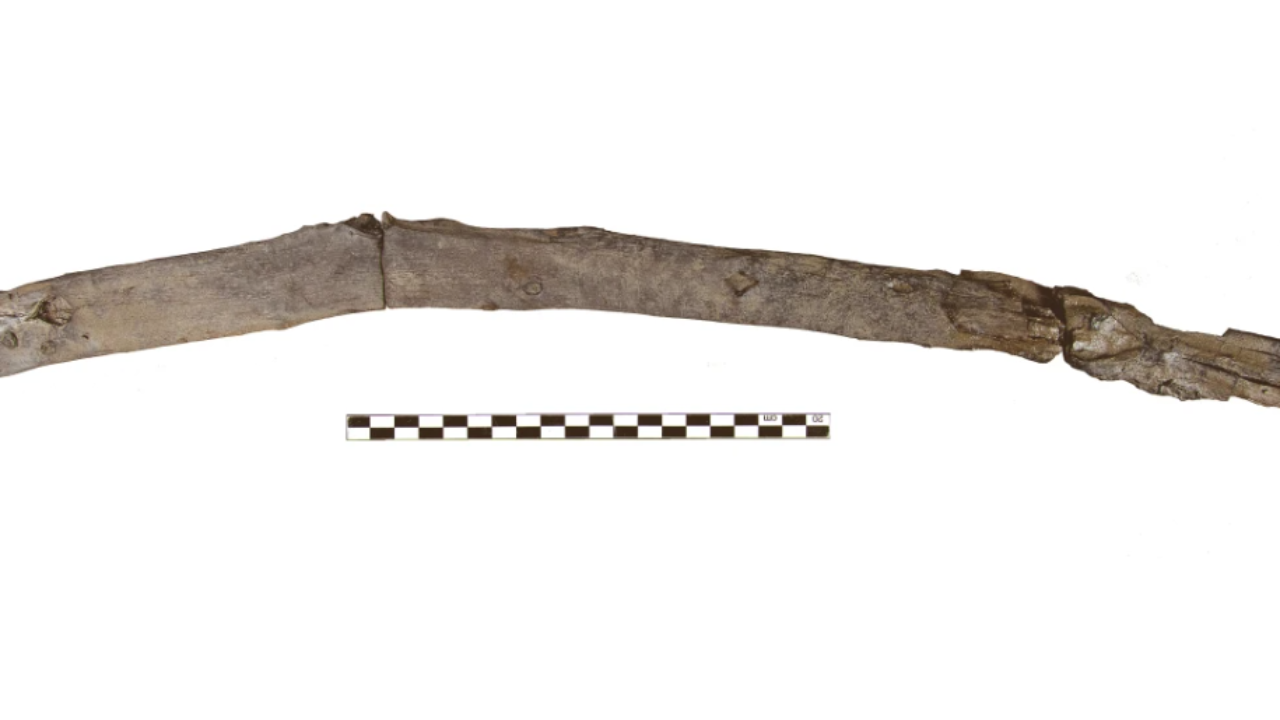
©(Katerina Harvati, Dimitris Michailidis via AP)
Pre-reading Questions:
I will read each question. Then, please answer them.
講師がそれぞれの質問を読むので答えましょう。
- Have you ever used a tool made of wood?
- Have you ever seen something very old in real life?
Vocabulary:
I will read the words, meanings, and sample sentences. Then, repeat after me.
単語、意味、例文を読みます。講師に続いて音読しましょう。
- wooden /WOOD-n/
[adjective] – made of wood
The cabin has a wooden door and small windows. - lake /leyk/
[noun] – a large area of water surrounded by land
The children played near a lake during their school trip. - shape /sheyp/
[verb] – to form or make something into a particular form
The artist used clay to shape a small animal. - prevent /pri-VENT/
[verb] – to stop something from happening
Wearing a helmet can prevent head injuries. - site /sahyt/
[noun] – a place where something happens or is located
The company chose a new site for the office building.
Article Reading:
Please read the whole article. Then, I will check your pronunciation and intonation.
記事を音読しましょう。講師はあなたの発音とイントネーションを確認します。
Archaeologists have discovered two ancient wooden tools near an old lake in the Megalopolis basin of southern Greece. The tools are about 430,000 years old and are the oldest wooden tools known so far. The discovery was published in the journal Proceedings of the National Academy of Sciences. One tool is a long wooden stick about 80 centimeters in length and was likely used for digging in soft soil. The second tool is a smaller piece of wood made from willow or poplar and may have been used to help shape stone tools. Wooden tools are rarely found because wood usually decays over time.The tools were preserved because they were quickly covered by soil and stayed in a wet environment. This helped prevent the wood from breaking down. Similar wet conditions have preserved wooden tools in other countries. No human remains have been found at the site, but the tools may have been used by Neanderthals or other early humans. The discovery shows that wood was an important material for making tools in the past.
True or False:
Read the sentences and identify if they are true or false based on the article.
文章を読んで、記事に基づいて正誤を答えましょう。
- The tools are about 4,300 years old.
- The long wooden stick was used to cut animal bones.
- The second tool was made from metal.
- Wooden tools are easy to find because wood lasts a long time.
- Wet conditions helped protect the wooden tools.
Fill in the Blanks:
Choose the correct word from the table, then fill in the blanks.
適切な言葉を選んで空欄を埋めましょう。
| wooden | lake | shape | prevent | site |
- The festival ______ was busy with many visitors.
- She placed the books on a ______ shelf in her room.
- Many birds live around the ______ in the national park.
- The worker uses a tool to ______ the metal carefully.
- The teacher spoke clearly to ______ confusion.