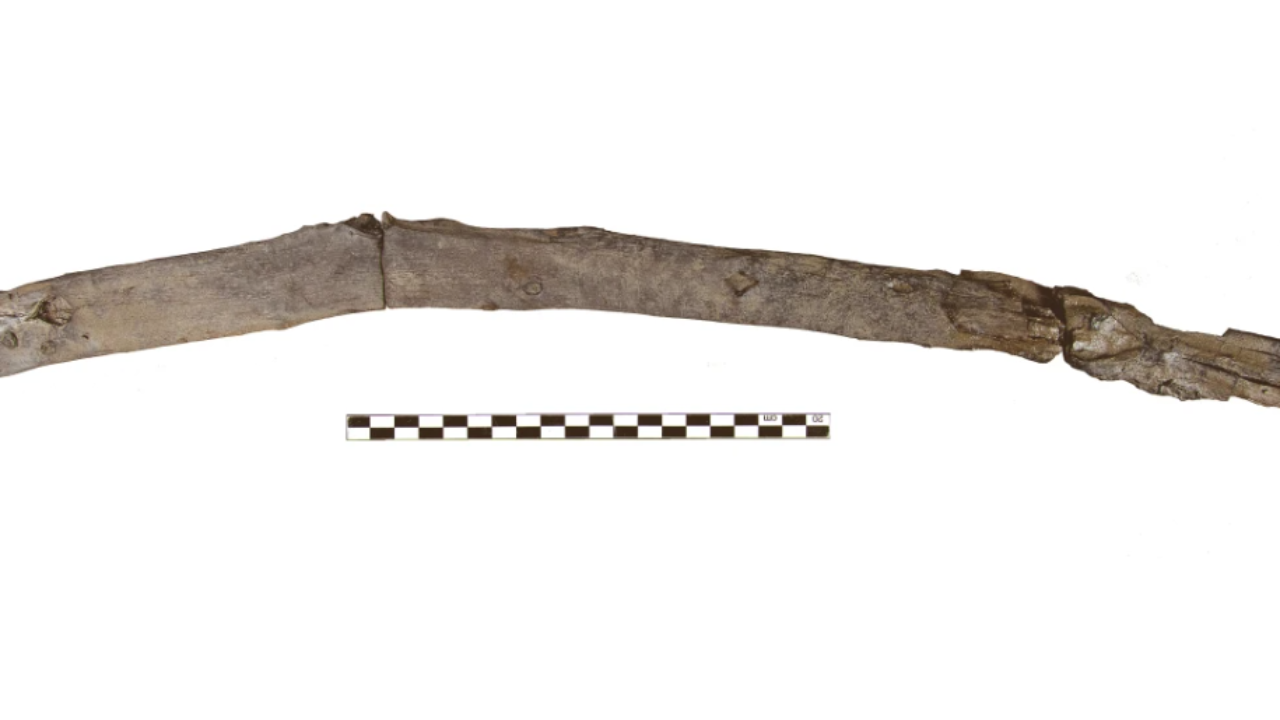
©(Katerina Harvati, Dimitris Michailidis via AP)
Pre-reading Questions:
I will read each question. Then, please answer them.
- Why do you think people keep old objects?
- What kind of tools do you use every day?
Vocabulary:
I will read the words, meanings, and sample sentences. Then, repeat after me.
- archaeologist /ahr-kee-OL-uh-jist/
[noun] – a person who studies people from the past by looking at old objects
The archaeologist reported a new discovery at the desert site. - ancient /EYN-shuhnt/
[adjective] – very old and from a long time ago
The city is famous for its ancient buildings. - artifact /AHR-tuh-fakt/
[noun] – an object made by people in the past
The museum displayed an artifact from an old village. - willow /WIL-oh/
[noun] – a type of tree with long, thin branches
A willow grows near the river in the park. - preserve /pri-ZURV/
[verb] – to keep something in good condition for a long time
Old photos are carefully preserved in the library.
Article Reading:
Please read the whole article. Then, I will check your pronunciation and intonation.
Archaeologists have reported the discovery of two ancient wooden tools near the shore of an old lake in the Megalopolis basin of southern Greece. The tools are estimated to be about 430,000 years old, making them the oldest wooden tools known so far. The findings were published in the journal Proceedings of the National Academy of Sciences. One artifact is a thin wooden stick about 80 centimeters long and was likely used for digging in soft ground. The second artifact is a smaller wooden piece made from willow or poplar and may have been used to shape stone tools. Wooden tools are rarely preserved because wood decays easily, which makes this discovery important for understanding early human technology. The age of the tools was identified through geological layers at the site, where stone tools and animal bones with cut marks were also found.
The tools survived because they were quickly buried by sediment and remained in a wet environment, which slowed decay. Researchers noted that similar conditions helped preserve ancient wooden tools found in other regions. No human remains have been discovered at the site, but the tools may have been used by Neanderthals or other early human groups. The discovery provides rare evidence of wooden technology and suggests that more wooden artifacts may still be present at the site.
The tools survived because they were quickly buried by sediment and remained in a wet environment, which slowed decay. Researchers noted that similar conditions helped preserve ancient wooden tools found in other regions. No human remains have been discovered at the site, but the tools may have been used by Neanderthals or other early human groups. The discovery provides rare evidence of wooden technology and suggests that more wooden artifacts may still be present at the site.
Comprehension Questions:
I will read each question. Then, please answer them based on the article.
- What did archaeologists discover near the shore of an old lake?
- How old are the wooden tools estimated to be?
- What wooden artifacts are described in the article?
- What was the thin wooden stick likely used for?
- Why did the tools survive for a long time?
Discussion Questions:
I will read each question. Then, please answer them.
- Have you ever used a wooden tool, like a stick or a wooden handle? If so, what did you use it for? If not, what wooden tool do you see people use every day?
- Have you ever seen something very old, like in a museum or outside? If so, where did you see it? If not, what old thing do you think is interesting?
- Do you agree that wood was important for early people?
- How do you think life was different without modern tools?
- Why do you think people are excited when archaeologists find old tools?