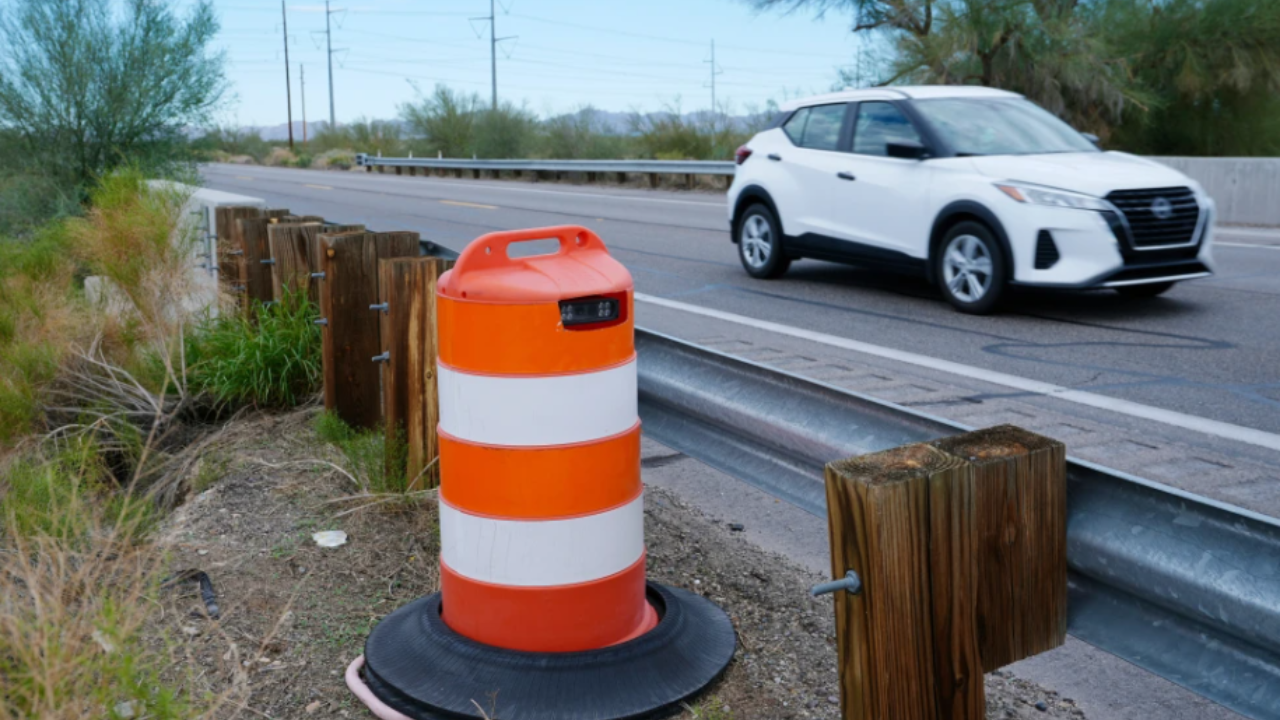
©(AP Photo/Ross D. Franklin, File)
Pre-reading Questions:
I will read each question. Then, please answer them.
- What do you think is more important, safety or privacy? Why?
- How do you imagine roads will look in the future with new technology?
Vocabulary:
I will read the words, meanings, and sample sentences. Then, repeat after me.
- detect /dih-TEKT/
[verb] – to discover or notice something that is not easy to see
Sensors detect smoke early to prevent fires. - algorithm /AL-guh-rith-uhm/
[noun] – a set of steps used by a computer to solve a problem
The app uses an algorithm to show popular videos. - violation /vahy-uh-LEY-shuhn/
[noun] – an action that breaks a rule or law
Parking in that area is a violation of city rules. - enforcement /en-FAWRS-muhnt/
[noun] – the act of making sure laws or rules are followed
School enforcement of rules helps keep order. - transparency /trans-PAIR-uhn-see/
[noun] – openness and clear sharing of information
Transparency helps build trust in a company.
Article Reading:
Please read the whole article. Then, I will check your pronunciation and intonation.
Government surveillance using license plate readers has received increased attention in the United States, particularly in Southern California over the past year. The issue became public in 2024 after an investigation found that federal agencies placed hidden cameras along roads in San Diego and Imperial counties near the border with Mexico. The cameras were concealed inside traffic equipment such as construction barrels, making them difficult to detect. Privacy groups and advocacy organizations raised concerns because the system collected data from millions of drivers without clear public notice. The data was linked to a predictive intelligence program operated by U.S. Border Patrol to analyze travel patterns and identify vehicles considered suspicious.
The system records license plate numbers, locations, and travel times, then processes the information using computer algorithms. Court documents show that vehicles may be flagged based on travel routes, speed, or time spent near border areas. Federal agencies can share this information with local police, which may lead to traffic stops for minor violations. Supporters of the technology say it helps improve enforcement and national security. Critics argue that the system lacks transparency and may affect ordinary drivers. Legal experts have called for stronger oversight, clear rules, and limits to ensure that surveillance tools are used proportionally and within legal boundaries.
The system records license plate numbers, locations, and travel times, then processes the information using computer algorithms. Court documents show that vehicles may be flagged based on travel routes, speed, or time spent near border areas. Federal agencies can share this information with local police, which may lead to traffic stops for minor violations. Supporters of the technology say it helps improve enforcement and national security. Critics argue that the system lacks transparency and may affect ordinary drivers. Legal experts have called for stronger oversight, clear rules, and limits to ensure that surveillance tools are used proportionally and within legal boundaries.
Comprehension Questions:
I will read each question. Then, please answer them based on the article.
- When did the issue about hidden cameras become public?
- Where were the cameras hidden?
- Why did privacy groups and advocacy organizations raise concerns?
- What information does the system record from vehicles?
- What do legal experts say is needed for the use of surveillance tools?
Discussion Questions:
I will read each question. Then, please answer them.
- Have you seen cameras on roads or streets near where you live? If so, where did you see them? If not, where do you think cameras are usually placed?
- Do you often travel by car or bus on main roads? If so, what do you notice on the road, like signs or equipment? If not, how do people usually travel in your area?
- Do you agree that people should know when cameras collect travel data?
- What problems could happen if travel data is not clear to the public?
- Why are clear rules important when using surveillance tools?