©Gabor Lakos, Budapest History Museum via AP
Pre-reading Questions:
I will read each question. Then, please answer them.
- What kinds of objects do archaeologists usually find in ancient tombs?
- Why do historians study burial sites from ancient civilizations?
Vocabulary:
I will read the words, meanings, and sample sentences. Then, repeat after me.
- sarcophagus /sahr-KOF-uh-guhs/
[noun] – a stone coffin used in ancient times
The museum displayed a large sarcophagus from the Roman period. - excavation /ek-skuh-VEY-shuhn/
[noun] – the activity of digging in the ground to discover objects from the past
The excavation lasted several months. - skeleton /SKEL-i-tuhn/
[noun] – the structure of bones in a human or animal body
Scientists studied the skeleton to learn about the person’s age. - ruins /ROO-inz/
[noun] – the remains of buildings that are damaged or destroyed
Tourists visited the ruins of the ancient city. - burial /BER-ee-uhl/
[noun] – the act of putting a dead body into the ground
The burial followed traditional customs.
Article Reading:
Please read the whole article. Then, I will check your pronunciation and intonation.
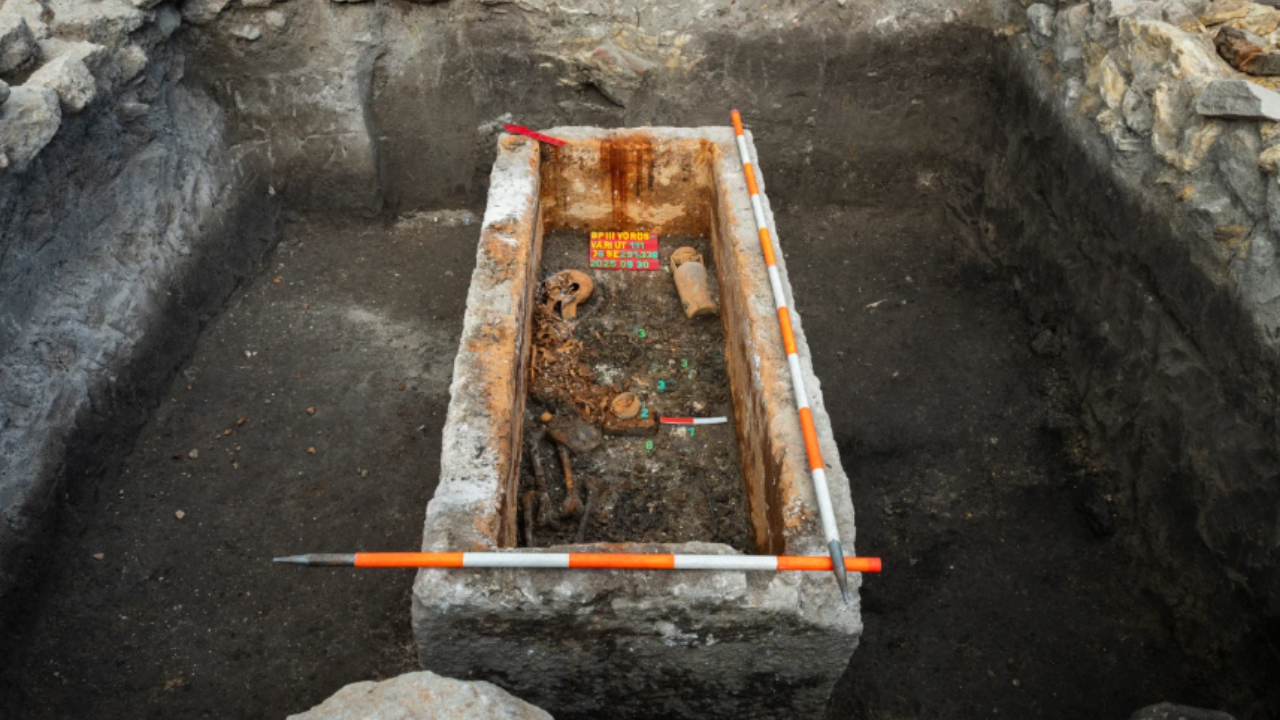
Archaeologists discovered a Roman sarcophagus during a large excavation in Budapest, Hungary, revealing new information about life in the region around 1,700 years ago. The stone coffin was found in the Óbuda district, once part of Aquincum, a Roman settlement near the Danube River. Researchers from the Budapest History Museum reported that the coffin remained sealed under its original stone lid. When the lid was carefully lifted, a complete skeleton was found inside. Around the bones were many objects placed in the tomb long ago, including glass containers, bronze statues, and about 140 coins. The rare condition of the discovery surprised archaeologists because the tomb had not been opened or damaged for centuries.
The coffin was located among the ruins of houses in an area that later became a Roman cemetery. Archaeologists also uncovered several other graves nearby, but none contained as many objects as this one. The items placed beside the body followed Roman traditions, where families added gifts to help the dead in the afterlife. Experts believe the careful burial and valuable objects suggest the young woman belonged to a wealthy or respected family connected to the nearby Roman military settlement along the empire’s frontier.
The coffin was located among the ruins of houses in an area that later became a Roman cemetery. Archaeologists also uncovered several other graves nearby, but none contained as many objects as this one. The items placed beside the body followed Roman traditions, where families added gifts to help the dead in the afterlife. Experts believe the careful burial and valuable objects suggest the young woman belonged to a wealthy or respected family connected to the nearby Roman military settlement along the empire’s frontier.
Comprehension Questions:
I will read each question. Then, please answer them based on the article.
- Where was the Roman sarcophagus discovered?
- Which organization conducted the excavation?
- What did archaeologists find inside the coffin?
- Name two objects discovered in the tomb.
- Why was the discovery unusual?
Discussion Questions:
I will read each question. Then, please answer them.
- Have you ever visited a museum with ancient objects? If so, what did you see? If not, which type of artifact would interest you most?
- Have you ever learned about Roman history in school? If so, what topic was most interesting? If not, would learning about it be interesting?
- Do you agree that archaeological discoveries are important for understanding ancient cultures?
- Why might families include valuable objects in graves?
- How might scientists learn more about a person by studying bones and artifacts?