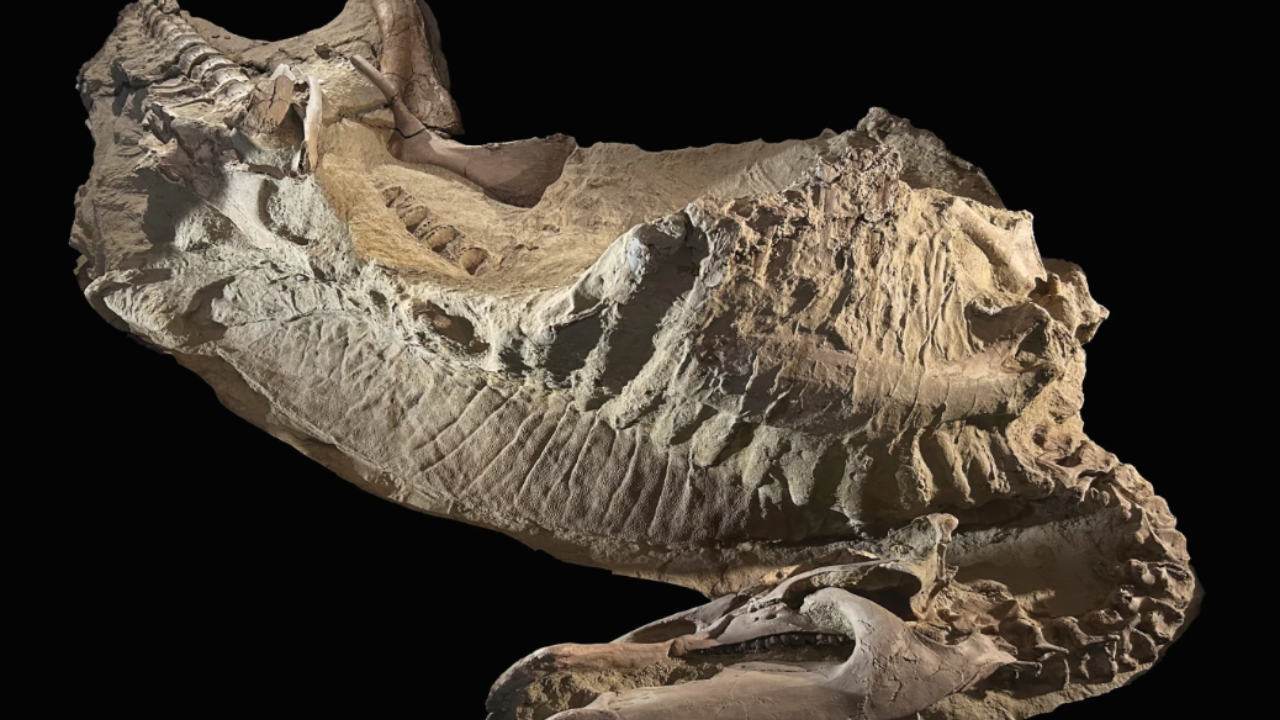
©Tyler Keillor, The University of Chicago via AP
Vocabulary:
I will read the words, meanings, and sample sentences. Then, repeat after me.
- profound /pruh-FOUND/
[adjective] – felt or experienced very strongly or in an extreme way
The scientist felt a profound sense of wonder after the discovery. - intricate /IN-tri-kit/
[adjective] – having many small parts that are arranged in a complicated or detailed way
The fossil showed intricate patterns that amazed the researchers. - meticulous /muh-TIK-yuh-luhs/
[adjective] – very careful and with great attention to every detail
The scientist was meticulous when examining the tiny fossil marks. - invaluable /in-VAL-yoo-uh-buhl/
[adjective] – extremely useful or important
The new fossils provided invaluable information about dinosaur life. - transformative /trans-FAWR-muh-tiv/
[adjective] – causing a major change to something or someone, especially in a way that improves it
The study had a transformative effect on how fossils are understood.
Article Reading:
Please read the whole article. Then, I will check your pronunciation and intonation.
Scientists have recently discovered two rare dinosaur mummies in eastern Wyoming, providing profound insight into prehistoric preservation. The fossils, found in an area known to paleontologists as the “mummy zone,” belong to a young duck-billed dinosaur species that lived about 70 million years ago. Unlike traditional mummies preserved through wrapping or desiccation, these dinosaurs became “mummified” when their skin and soft tissues fossilized. Researchers believe the remains were rapidly covered by fine clay sediment soon after death, preventing decay and capturing detailed impressions of the animals’ scales and body texture. The findings were announced in Science, highlighting an unusual process that challenges existing assumptions about how fossils can form on land.
Further examination revealed that microbes likely played an essential role in this intricate natural preservation. Instead of fossilized skin, scientists found meticulous clay molds that recorded the dinosaurs’ outer patterns with remarkable precision. Using these impressions, researchers reconstructed what the duck-billed dinosaurs might have looked like, including spikes along their tails and hoof-shaped feet. Experts suggested that microbial activity and environmental conditions together produced this unique mummification style, expanding scientific understanding of terrestrial fossilization. This discovery may encourage paleontologists to search for more subtle traces, such as skin or soft-tissue impressions, in future excavations. According to specialists, each newly found dinosaur mummy represents an invaluable opportunity to study how ancient creatures lived and evolved. The research underscores the transformative potential of scientific observation in revealing long-lost details of Earth’s biological history.
Further examination revealed that microbes likely played an essential role in this intricate natural preservation. Instead of fossilized skin, scientists found meticulous clay molds that recorded the dinosaurs’ outer patterns with remarkable precision. Using these impressions, researchers reconstructed what the duck-billed dinosaurs might have looked like, including spikes along their tails and hoof-shaped feet. Experts suggested that microbial activity and environmental conditions together produced this unique mummification style, expanding scientific understanding of terrestrial fossilization. This discovery may encourage paleontologists to search for more subtle traces, such as skin or soft-tissue impressions, in future excavations. According to specialists, each newly found dinosaur mummy represents an invaluable opportunity to study how ancient creatures lived and evolved. The research underscores the transformative potential of scientific observation in revealing long-lost details of Earth’s biological history.
Discussion Questions:
I will read each question. Then, please answer them.
- Have you ever visited a museum or seen a fossil display? If so, what did you find most interesting? If not, would you like to go?
- Have you watched a movie or documentary about dinosaurs? If so, what did you learn from it? If not, which one would you like to see?
- Do you agree that studying fossils helps people understand Earth’s past better?
- Why do you think these fossils are important for understanding ancient life?
- What challenges might scientists face when trying to preserve soft tissues in fossils?
Summarization:
Please summarize the whole article using your own words and expressions. You will have one minute to prepare before you answer.
Describe:
Please explain the definition of each word listed below based on your understanding. You can provide example sentences if needed.
- rare
- tissue
- decay
- reconstruct
- specialist