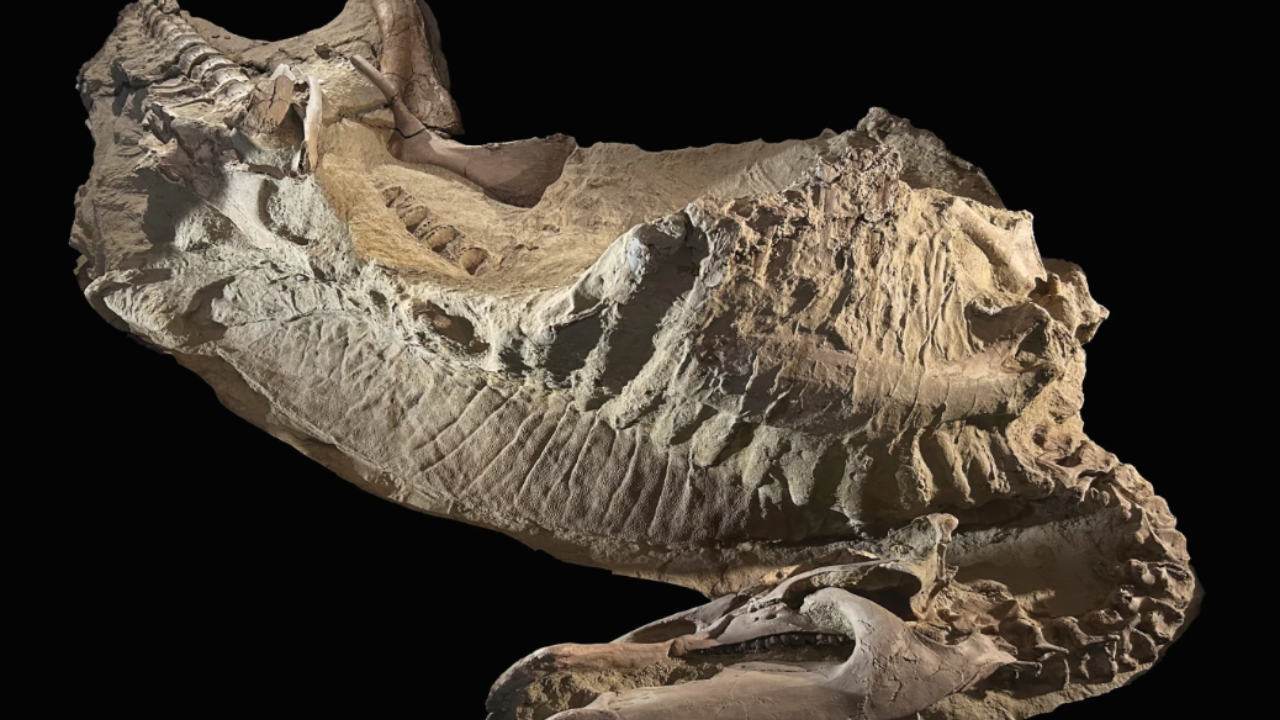
©Tyler Keillor, The University of Chicago via AP
Pre-reading Questions:
I will read each question. Then, please answer them.
- Have you ever visited a museum that showed dinosaur fossils or bones? If so, what did you find most interesting? If not, would you like to visit one?
- Have you ever seen a scientific discovery on TV or the internet? If so, what was it about? If not, what kind of discovery would you like to learn about?
Vocabulary:
I will read the words, meanings, and sample sentences. Then, repeat after me.
- noteworthy /NOHT-wur-thee/
[adjective] – deserving attention because of being important or interesting
The teacher’s project was noteworthy for its creative design. - compelling /kuhm-PEL-ing/
[adjective] – very exciting and interesting and making you want to watch or listen
The movie was so compelling that everyone stayed until the end. - facilitate /fuh-SIL-i-teyt/
[verb] – to make something possible or easier
Good communication can facilitate teamwork in the classroom. - accuracy /AK-yer-uh-see/
[noun] – the fact of being exact or correct
The scientist checked the accuracy of the experiment’s results. - exceptional /ik-SEP-shuh-nl/
[adjective] – much greater than usual, especially in skill, intelligence, quality, etc.
The student showed exceptional skill in solving math problems.
Article Reading:
Please read the whole article. Then, I will check your pronunciation and intonation.
Scientists have recently discovered two rare dinosaur mummies in eastern Wyoming, offering profound and noteworthy insight into prehistoric preservation. The fossils, found in an area called the “mummy zone,” came from young duck-billed dinosaurs that lived around 70 million years ago. These ancient animals became “mummified” when their skin and soft tissues changed into fossils instead of drying like human mummies. Experts explained that the dinosaurs’ bodies were quickly covered by fine clay after death, which stopped decay and captured detailed skin textures. The study, published in Science, gave compelling evidence of how special natural conditions can facilitate fossilization, improving the accuracy of how scientists interpret ancient environments.
Further analysis showed that tiny organisms, called microbes, helped in this intricate process. Scientists discovered meticulous clay molds that recorded body details like scales and spikes with exceptional precision. Using these molds, researchers reconstructed the dinosaurs’ distinctive appearance, including their tails, feet, and outer patterns. Experts believe that both environmental and biological factors worked together in this process. The discovery is an invaluable contribution to paleontology, offering a transformative and captivating look into ancient ecosystems and how new findings can enrich knowledge about life that existed millions of years ago.
Further analysis showed that tiny organisms, called microbes, helped in this intricate process. Scientists discovered meticulous clay molds that recorded body details like scales and spikes with exceptional precision. Using these molds, researchers reconstructed the dinosaurs’ distinctive appearance, including their tails, feet, and outer patterns. Experts believe that both environmental and biological factors worked together in this process. The discovery is an invaluable contribution to paleontology, offering a transformative and captivating look into ancient ecosystems and how new findings can enrich knowledge about life that existed millions of years ago.
Comprehension Questions:
I will read each question. Then, please answer them based on the article.
- Where were the two dinosaur mummies discovered?
- What kind of dinosaurs were found in the “mummy zone”?
- About how many years ago did these dinosaurs live?
- What happened to the dinosaurs’ bodies after they died?
- What material covered the dinosaurs’ bodies after death?
Discussion Questions:
I will read each question. Then, please answer them.
- Have you ever visited a museum that showed dinosaur fossils or bones? If so, what did you find most interesting? If not, would you like to visit one?
- Have you ever seen a scientific discovery on TV or the internet? If so, what was it about? If not, what kind of discovery would you like to learn about?
- Do you agree that new scientific discoveries help people understand the past better?
- Why do you think it is important for scientists to study how fossils are formed?
- What can this tell us about the Earth’s history?