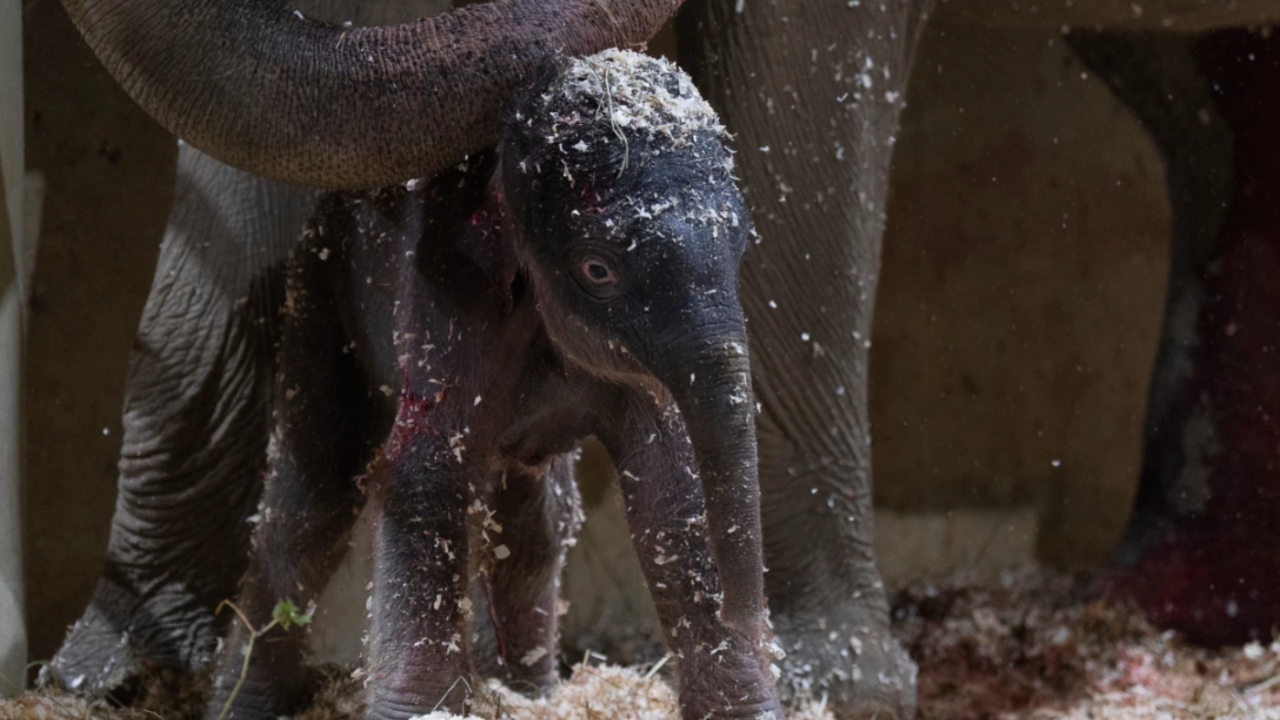
©Amanda Carberry/Columbus Zoo and Aquarium via AP
Pre-reading Questions:
I will read each question. Then, please answer them.
- What zoo animals are commonly involved in conservation programs? How do these programs help protect endangered wildlife?
- What challenges do large animals face in the wild? How do zoos help reduce these challenges?
Vocabulary:
I will read the words, meanings, and sample sentences. Then, repeat after me.
- proliferation /pruh-lif-uh-RAY-shuhn/
[noun] – a rapid increase in number
Scientists studied the proliferation of new plants. - integrative /IN-tuh-gray-tiv/
[adjective] – combining different parts to make a whole system
The team used an integrative approach to solve problems. - conservationist /kon-ser-VAY-shuh-nist/
[noun] – someone who works to protect natural environments
A conservationist explained the need for forest care. - reciprocal /ri-SIP-ruh-kuhl/
[adjective] – describing an action done equally by two sides
The groups formed a reciprocal partnership. - imperative /im-PAIR-uh-tiv/
[adjective] – extremely important or necessary
Safety checks are imperative during research.
Article Reading:
Please read the whole article. Then, I will check your pronunciation and intonation.
The Columbus Zoo and Aquarium announced that an Asian elephant calf was born on October 22, marking the first time in nearly a century that the Ohio facility recorded two elephant births within a single year. The event added to the zoo’s ongoing efforts to expand managed populations amid concerns about the proliferation of threats facing Asian elephants in the wild. Staff reported that the mother, Phoebe, delivered the male calf at 10:41 p.m. inside a controlled environment designed to protect early bonding. Access remains limited while teams observe the newborn’s first movements and nursing attempts. Officials explained that the birth supports broader goals tied to species survival programs in accredited zoos across the country.
The zoo noted that medical teams continue their work under an integrative care approach that includes conservation planning, behavioral support, and health monitoring. The calf’s father, Sabu, resides at the Cincinnati Zoo and was paired with Phoebe through a national breeding strategy directed by conservationist groups seeking to strengthen genetic diversity. Experts emphasized that cooperation among institutions reflects a reciprocal responsibility to protect animals affected by habitat loss and fragmentation. The zoo added that maintaining viable populations under professional care is imperative as pressures in the wild persist. Phoebe’s earlier calf, born in 2021, remains part of the herd along with other adults and a younger calf delivered four months ago. Officials plan to release additional updates about public-viewing schedules, naming processes, and developmental progress.
The zoo noted that medical teams continue their work under an integrative care approach that includes conservation planning, behavioral support, and health monitoring. The calf’s father, Sabu, resides at the Cincinnati Zoo and was paired with Phoebe through a national breeding strategy directed by conservationist groups seeking to strengthen genetic diversity. Experts emphasized that cooperation among institutions reflects a reciprocal responsibility to protect animals affected by habitat loss and fragmentation. The zoo added that maintaining viable populations under professional care is imperative as pressures in the wild persist. Phoebe’s earlier calf, born in 2021, remains part of the herd along with other adults and a younger calf delivered four months ago. Officials plan to release additional updates about public-viewing schedules, naming processes, and developmental progress.
Comprehension Questions:
I will read each question. Then, please answer them based on the article.
- What major event did the zoo announce?
- When did the birth take place?
- Why is this birth historically important?
- Why is access to the calf restricted?
- What behavior is being observed?
Discussion Questions:
I will read each question. Then, please answer them.
- What zoo births have you heard about before? If so, what details from those announcements stood out? If not, what type of zoo birth would you be most interested in hearing about?
- What conservation stories have been reported in your area? If so, what positive effects were described in those reports? If not, what kind of conservation story would you like to see in your community?
- Do you agree that zoos should help endangered animals?
- Why is it important to protect animal habitats?
- How can zoos teach people about endangered animals?