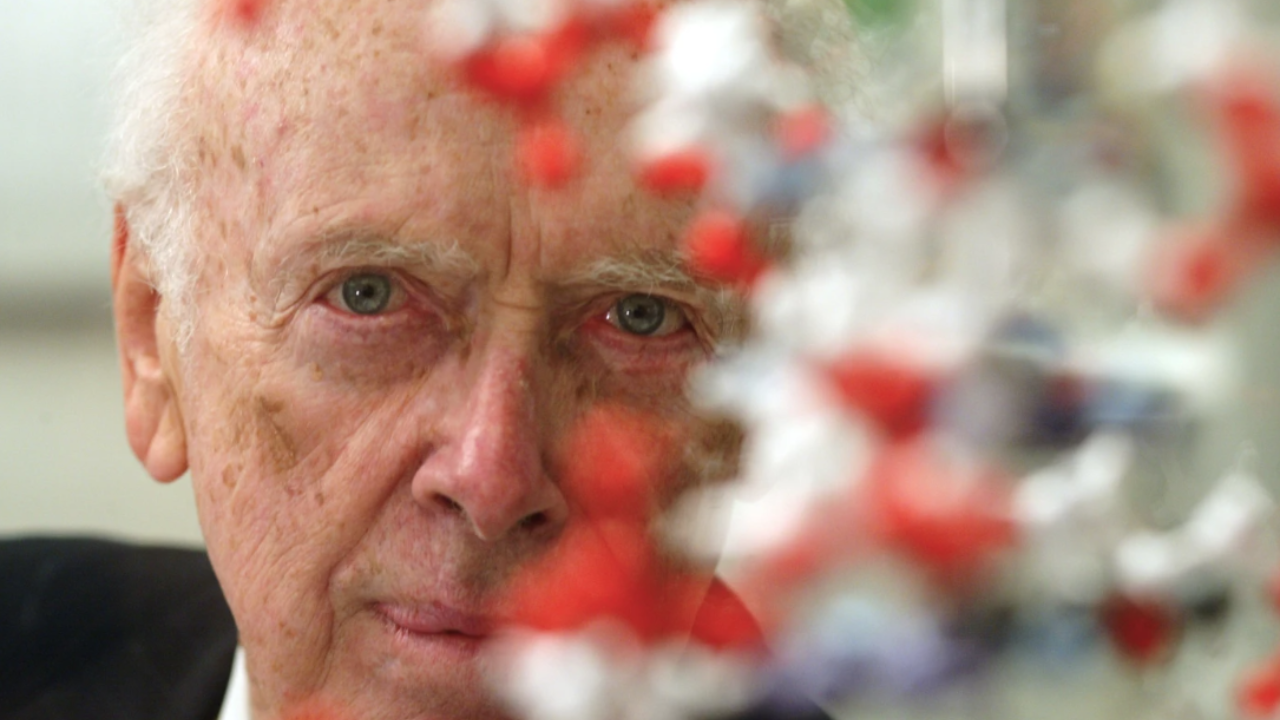
©AP Photo/Markus Schreiber, File
Vocabulary:
I will read the words, meanings, and sample sentences. Then, repeat after me.
- landmark /LAM-mark/
[noun] – an important stage or discovery
The research team celebrated a landmark achievement in medical testing. - discernable /dih-SUR-nuh-buhl/
[adjective] – able to be seen, recognized, or understood
There was a discernible change in climate patterns last year. - reconstruct /ree-kon-STRUHKT/
[verb] – to build or form something again
Engineers worked to reconstruct the collapsed bridge. - assertion /uh-SUR-shun/
[noun] – a confident and usually firm statement
The scientist made an assertion about the new procedure’s safety. - subsequent /SUB-si-kwent/
[adjective] – happening after something else
The team revised its plan after the subsequent findings.
Article Reading:
Please read the whole article. Then, I will check your pronunciation and intonation.
James Watson, a central figure in modern biology, remained a landmark presence in scientific history as institutions continued to reflect on the discovery that reshaped genetics. The Chicago-born researcher first recognized the now-famous double helix on a February morning in 1953 while arranging cardboard cutouts to determine how DNA could store hereditary data. His insight offered a discernible explanation for gene function and helped clarify why the molecule’s structure enabled reliable transmission of traits. Officials noted that the discovery’s significance extended far beyond the laboratory, influencing medicine, agriculture, forensics, and ethical debate. Historians said the breakthrough altered the course of biological research and continued to guide global studies of molecular biology.
In later decades, Watson helped reconstruct major scientific programs, including the federal effort to map human DNA. His assertion that understanding the genome could advance research was widely discussed in scientific circles. Watson’s influence expanded through textbooks, institutional leadership, and talent development. Biologists acknowledged that the 1953 DNA model accelerated key advances such as gene-based therapies, investigative identification techniques, and broader study of inherited disease. Several honors were adjusted in subsequent years as institutions reviewed historical records and contributions. Historians emphasized that Rosalind Franklin’s X-ray data and the work of collaborators Francis Crick, Maurice Wilkins, and Raymond Gosling were essential to the breakthrough. Experts noted that discussions about fairness, recognition, and genetics ethics remain intertwined with Watson’s scientific legacy.
In later decades, Watson helped reconstruct major scientific programs, including the federal effort to map human DNA. His assertion that understanding the genome could advance research was widely discussed in scientific circles. Watson’s influence expanded through textbooks, institutional leadership, and talent development. Biologists acknowledged that the 1953 DNA model accelerated key advances such as gene-based therapies, investigative identification techniques, and broader study of inherited disease. Several honors were adjusted in subsequent years as institutions reviewed historical records and contributions. Historians emphasized that Rosalind Franklin’s X-ray data and the work of collaborators Francis Crick, Maurice Wilkins, and Raymond Gosling were essential to the breakthrough. Experts noted that discussions about fairness, recognition, and genetics ethics remain intertwined with Watson’s scientific legacy.
Discussion Questions:
I will read each question. Then, please answer them.
- What important scientific news has affected your community in recent years? If so, what impact did it have? If not, what type of scientific news would likely get attention?
- Has any discovery changed how people around you view health or identity If so, how did their views change? If given the chance to observe a major research project, what part of the process would be most interesting?
- Do scientific achievements remain valuable even when debates or disagreements arise about the research involved?
- How should scientific institutions balance achievement with accountability?
- What responsibilities arise when discoveries affect ethical or social issues?
Summarization:
Please summarize the whole article using your own words and expressions. You will have one minute to prepare before you answer.
Describe:
Please explain the definition of each word listed below based on your understanding. You can provide example sentences if needed.
- biology
- enable
- therapy
- genetics
- legacy