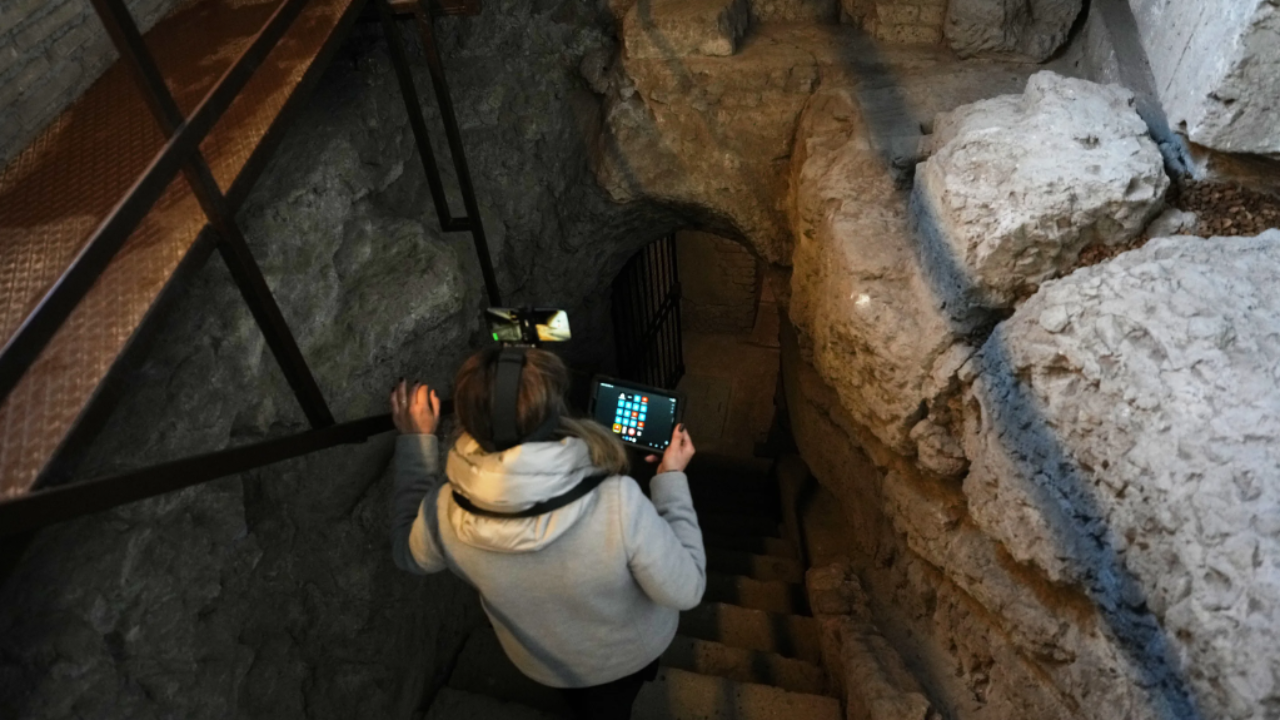
©(AP Photo/Andrew Medichini)
Vocabulary:
I will read the words, meanings, and sample sentences. Then, repeat after me.
- livestreamed /LAHYV-streemd/
[adjective] – broadcast in real time over the internet
The school offered a livestreamed graduation ceremony for families abroad. - wearable /WAIR-uh-buhl/
[adjective] – able to be worn on the body
The doctor tested a wearable device that tracks heart rate during exercise. - fragile /FRAJ-uhl/
[adjective] – easily damaged or broken
The bridge is fragile and requires careful inspection after storms. - fresco /FRES-koh/
[noun] – a wall painting made on fresh plaster
The museum restored a fresco found inside an old church. - mosaic /moh-ZEY-ik/
[noun] – an artwork made from small pieces of stone or glass
The city hall displayed a mosaic created by local artists.
Article Reading:
Please read the whole article. Then, I will check your pronunciation and intonation.
One of the best-preserved ancient Roman homes on Palatine Hill is being opened to the public through a new virtual program. The site, known as the House of the Griffins, was discovered during excavations in the early 20th century and dates back to the Roman Republic period. Palatine Hill, located near the Roman Forum and the Colosseum, served as an important residential area for wealthy citizens before the Roman Empire began. The house was later buried underground when Emperor Domitian built a palace above the site in the first century A.D., a development that contributed to long-term preservation. The virtual opening will begin on March 3 and aims to provide public access while ensuring strong protection of the structure. Archaeologists consider the house an important example of elite Roman domestic life due to its location, decorative quality, and condition.
The visit is offered through a livestreamed tour led by a guide using a wearable camera, allowing viewers to observe rooms that remain difficult to access. This approach represents an unprecedented method for opening fragile archaeological spaces to the public. Project experts explained that limiting physical entry reduces damage caused by humidity and carbon dioxide. Interior decorations include frescoes with painted marble designs and detailed floor mosaics, showing high artistic skill and financial resources. Restoration work followed a meticulous plan funded by the European Union as part of a broader effort to reduce pressure on major landmarks. The virtual system also supports education and tourism while safeguarding cultural heritage. Archaeological officials stated that the project seeks to encourage interest in less-visited areas and promote a deeper understanding of ancient Roman urban life.
The visit is offered through a livestreamed tour led by a guide using a wearable camera, allowing viewers to observe rooms that remain difficult to access. This approach represents an unprecedented method for opening fragile archaeological spaces to the public. Project experts explained that limiting physical entry reduces damage caused by humidity and carbon dioxide. Interior decorations include frescoes with painted marble designs and detailed floor mosaics, showing high artistic skill and financial resources. Restoration work followed a meticulous plan funded by the European Union as part of a broader effort to reduce pressure on major landmarks. The virtual system also supports education and tourism while safeguarding cultural heritage. Archaeological officials stated that the project seeks to encourage interest in less-visited areas and promote a deeper understanding of ancient Roman urban life.
Discussion Questions:
I will read each question. Then, please answer them.
- Have you ever visited an old building or historical place? If so, what part of the place was the most interesting? If not, what kind of historical place would you like to visit in the future?
- Have you ever joined an online tour or watched a virtual museum video? If so, what did you learn from that experience? If not, would you like to try a virtual tour? Why or why not?
- Do you agree that people can still learn history well without visiting a place in person?
- What problems might happen if too many visitors enter fragile historical places?
- How can technology help people understand ancient life better than books alone?
Summarization:
Please summarize the whole article using your own words and expressions. You will have one minute to prepare before you answer.
Describe:
Please explain the definition of each word listed below based on your understanding. You can provide example sentences if needed.
- site
- period
- access
- condition
- viewer