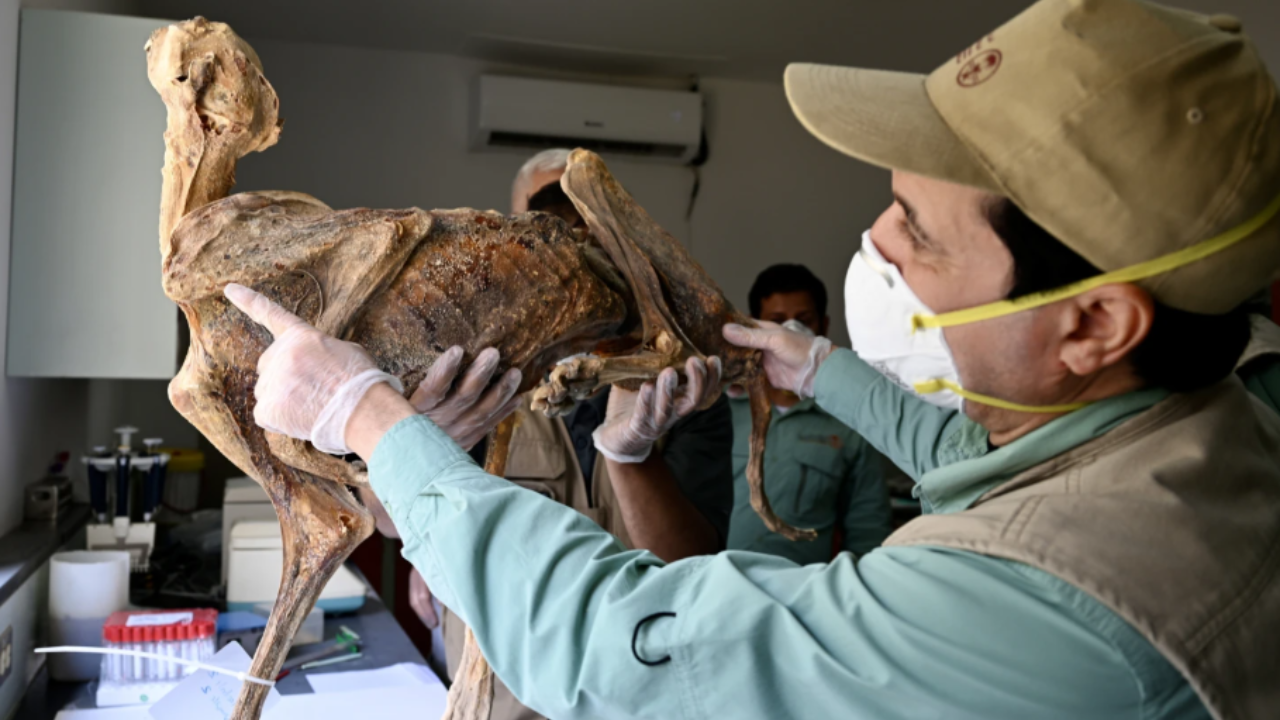
©(Ahmed Boug/Communications Earth and Environment via AP)
Pre-reading Questions:
I will read each question. Then, please answer them.
- When you hear about animals from the past, what kinds of places do you imagine they lived in?
- Why do you think people are interested in learning about animals that lived hundreds of years ago?
Vocabulary:
I will read the words, meanings, and sample sentences. Then, repeat after me.
- remain /ri-MEYN/
[noun] – what is left of something after it has ended or been destroyed
Scientists studied the remains of an ancient tool found near the river. - preserve /pri-ZURV/
[verb] – to keep something in its original condition
The museum works hard to preserve historical paintings. - mummification /muhm-i-fi-KAY-shuhn/
[noun] – the process of preserving a body by drying it
Mummification can happen naturally in very dry environments. - decay /dih-KEY/
[noun] – the process of slowly breaking down or rotting
Regular cleaning can slow the decay of old wooden houses. - genetic /juh-NET-ik/
[adjective] – related to genes passed from parents to children
Doctors study genetic information to understand some diseases.
Article Reading:
Please read the whole article. Then, I will check your pronunciation and intonation.
Scientists have discovered rare naturally mummified cheetah remains inside caves in northern Saudi Arabia, providing strong evidence that the species once lived in the region. The remains were found near the city of Arar and include seven mummified cheetahs, as well as bones from at least fifty-four other individuals. Scientific dating shows that the remains are between about one hundred thirty and more than one thousand eight hundred years old. Researchers described the discovery as unprecedented for the Arabian Peninsula, where large mammals are rarely preserved in such complete condition. The finding helps explain past ecosystems, as cheetahs once lived across Africa and parts of Asia but are no longer found in Arabia due to environmental changes.
The cheetahs were preserved through natural mummification caused by dry conditions and stable cave temperatures, which slowed decay and reduced access by scavengers. Researchers noted that such conditions are unusual for preserving large animals. Modern genetic testing allowed scientists to study ancient DNA from the remains and compare it with modern cheetah populations in Asia and northwest Africa. These genetic links may help researchers better understand cheetah history and population movement. The discovery combines archaeology, genetics, and wildlife research, offering valuable information about long-term biodiversity changes in arid regions.
The cheetahs were preserved through natural mummification caused by dry conditions and stable cave temperatures, which slowed decay and reduced access by scavengers. Researchers noted that such conditions are unusual for preserving large animals. Modern genetic testing allowed scientists to study ancient DNA from the remains and compare it with modern cheetah populations in Asia and northwest Africa. These genetic links may help researchers better understand cheetah history and population movement. The discovery combines archaeology, genetics, and wildlife research, offering valuable information about long-term biodiversity changes in arid regions.
Comprehension Questions:
I will read each question. Then, please answer them based on the article.
- What animals did scientists discover inside caves in northern Saudi Arabia?
- How many mummified cheetahs were discovered at the site?
- How old are the cheetah remains according to scientific dating?
- Why are cheetahs no longer found in Arabia today?
- What natural conditions helped preserve the cheetahs in the caves?
Discussion Questions:
I will read each question. Then, please answer them.
- Have you ever seen pictures or videos of animals that lived long ago? If so, where did you see them? If not, where do you think people can learn about animals from the past?
- Have you ever visited a cave, desert, or very dry place? If so, what was the place like? If not, would you like to visit such a place one day? Why or why not?
- Do you agree that studying ancient animal remains is important for understanding nature today?
- Why do you think it is rare to find large animals preserved in such good condition?
- What problems might happen if scientists cannot study ancient remains?