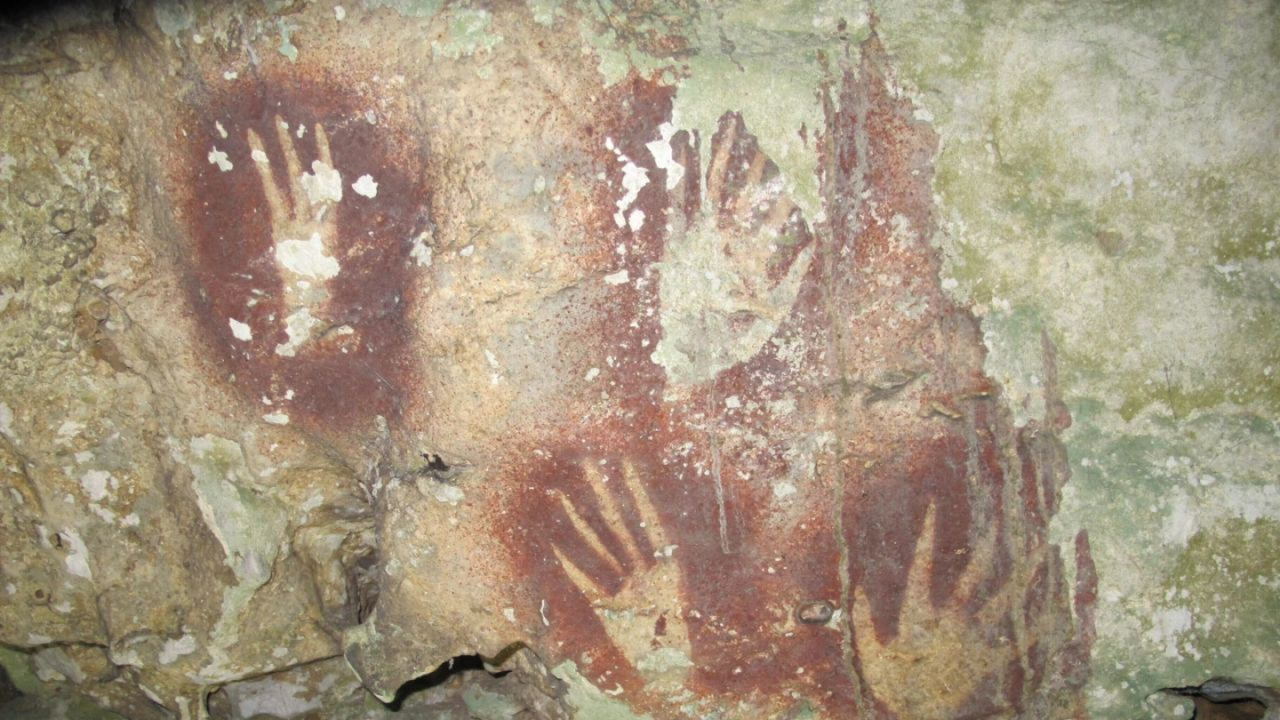
©(Ahdi Agus Oktaviana/Maxime Aubert via AP)
Pre-reading Questions:
I will read each question. Then, please answer them.
講師がそれぞれの質問を読むので答えましょう。
- Have you visited a very old place before?
- Do you think people long ago liked to make art?
Vocabulary:
I will read the words, meanings, and sample sentences. Then, repeat after me.
単語、意味、例文を読みます。講師に続いて音読しましょう。
- handprint /HAND-print/
[noun] – a mark made by a hand
A red handprint appeared on the white paper. - wall /wawl/
[noun] – a vertical surface that forms the side of a room or building
A clock hangs on the wall in the office. - pigment /PIG-muhnt/
[noun] – a colored substance used to make paint
Blue pigment made the sky look bright. - shape /sheyp/
[verb] – to form something into a special form
She shaped the clay into a small bowl. - island /AHY-luhnd/
[noun] – a piece of land surrounded by water
A small island can be seen from the beach.
Article Reading:
Please read the whole article. Then, I will check your pronunciation and intonation.
記事を音読しましょう。講師はあなたの発音とイントネーションを確認します。
Handprints found on cave walls in Indonesia may be the oldest rock art ever studied, dating back at least 67,800 years. Indonesian and Australian researchers discovered the prints on the island of Sulawesi inside limestone caves. The images were made by placing hands on the wall and blowing pigment around them. Some fingertips were shaped with care, showing clear planning. Scientists studied mineral layers on top of the paintings to measure age. The results showed the prints are very old and important for the study of early art.Researchers said the artwork shows that people on the island made art long before written history. The study was published in a scientific journal and raised questions about the artists. The prints may belong to Denisovans or to early modern humans traveling through the area. Other drawings nearby, such as animals and people, were made much later. Scientists believe older art may still be hidden on nearby islands. Future research may help explain how early people began to make art and share creative traditions.
True or False:
Read the sentences and identify if they are true or false based on the article.
文章を読んで、記事に基づいて正誤を答えましょう。
- The handprints found in Indonesia may be very old.
- The caves were made of limestone.
- The images were painted with brushes and pencils.
- All fingertips were left simple and not shaped.
- Scientists studied water inside the caves to find the age.
Fill in the Blanks:
Choose the correct word from the table, then fill in the blanks.
適切な言葉を選んで空欄を埋めましょう。
| handprint | wall | pigment | shaped | island |
- The picture fell from the ______ at night.
- The artist made a ______ with blue paint.
- The baker ______ the dough into a circle.
- Many birds live on the ______ near the lake.
- The teacher showed how ______ changes color in water.