Pre-reading Questions:
I will read each question. Then, please answer them.
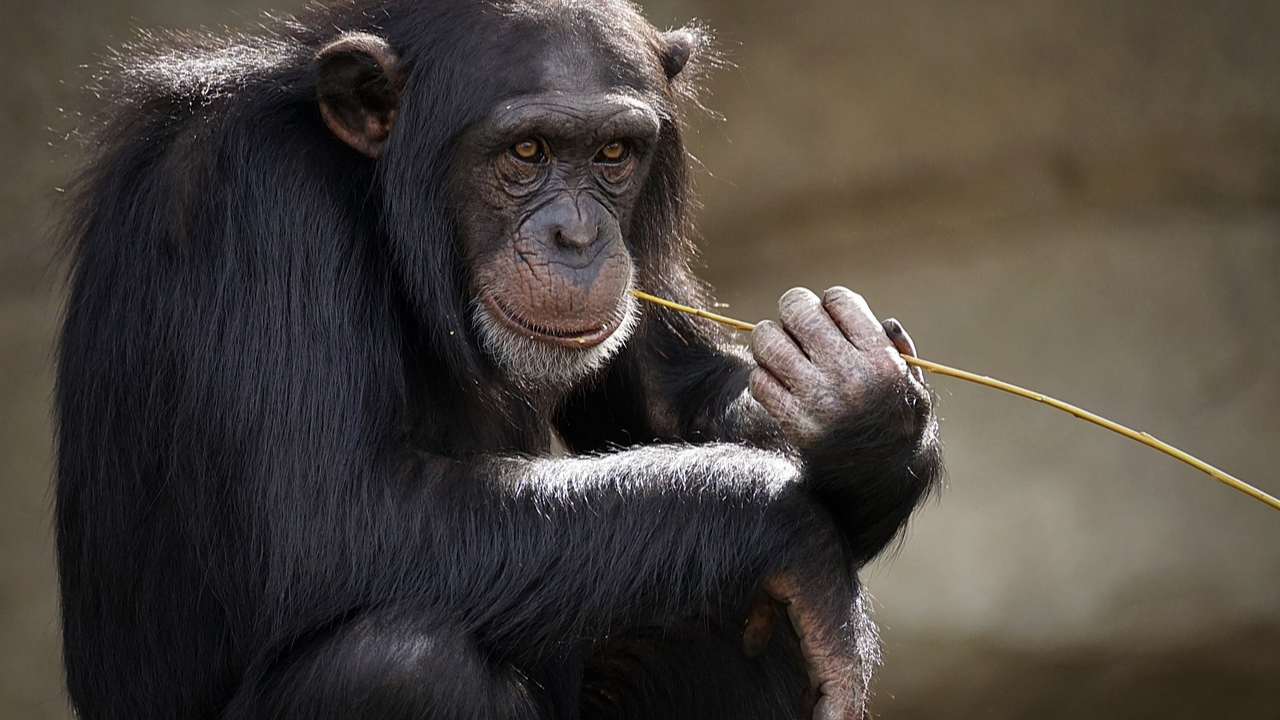
- What do you imagine when you think about apes?
- Do you think imagination is only for stories and games, or can it be useful in real life? Why?
Vocabulary:
I will read the words, meanings, and sample sentences. Then, repeat after me.
- captive /KAP-tiv/
[adjective] – kept under control and not free to leave
The captive animal stayed in a protected area for medical care. - indicate /IN-di-keyt/
[verb] – to show or point out something clearly
Signs on the road indicate the correct direction. - pour /pawr/
[verb] – to cause a liquid to flow from one container to another
Please pour the sauce slowly to avoid spilling. - abstract /AB-strakt/
[adjective] – related to ideas rather than physical objects
The lesson explains abstract concepts using simple examples. - version /VUR-zhuhn/
[noun] – a form of something that is different from another form
This book is a shorter version for young readers.
Article Reading:
Please read the whole article. Then, I will check your pronunciation and intonation.
A scientific report published in the journal Science suggests that imagination is not limited to humans. Researchers from Johns Hopkins University and the University of St. Andrews studied a captive bonobo named Kanzi to examine whether apes can understand make-believe situations. Imagination involves pretending that something is real while knowing it is not, and it is considered important for human creativity. Although some wild chimpanzees have shown similar behavior by using sticks as tools, this study provides the first formal evidence of such mental abilities in primates. The findings indicate that creative thinking may be a natural ability shared by several great ape species.
The investigation used social tests in which scientists poured invisible liquid into containers. Kanzi correctly chose the container meant to hold the liquid in 68 percent of the trials, showing an understanding of abstract ideas. To confirm that the bonobo was not confused, researchers offered a choice between real juice and an imaginary version. Kanzi selected the real juice in 80 percent of the cases, demonstrating a clear difference between reality and pretense. However, some experts, including Michael Tomasello, argue that more evidence is needed to prove full imaginative understanding. They also note that laboratory conditions may influence behavior. Despite these concerns, the study is considered an important step in animal psychology research.
The investigation used social tests in which scientists poured invisible liquid into containers. Kanzi correctly chose the container meant to hold the liquid in 68 percent of the trials, showing an understanding of abstract ideas. To confirm that the bonobo was not confused, researchers offered a choice between real juice and an imaginary version. Kanzi selected the real juice in 80 percent of the cases, demonstrating a clear difference between reality and pretense. However, some experts, including Michael Tomasello, argue that more evidence is needed to prove full imaginative understanding. They also note that laboratory conditions may influence behavior. Despite these concerns, the study is considered an important step in animal psychology research.
Comprehension Questions:
I will read each question. Then, please answer them based on the article.
- What does the scientific report say about imagination and humans?
- Which animal did the researchers study in the experiment?
- What does imagination involve, according to the article?
- What similar behavior have some wild chimpanzees shown?
- What concern do some experts have about the study?
Discussion Questions:
I will read each question. Then, please answer them.
- Have you learned about animals in science class before? If yes, what animal did you learn about? If not, what animal would you like to learn about?
- Have you ever watched a video or read a story about apes or chimpanzees? If yes, what did you see? If not, where do you usually learn about animals?
- Do you agree that animals can think in creative ways like humans?
- Why do scientists study apes to learn about thinking and behavior?
- Why do you think some animals are very good at learning new things?