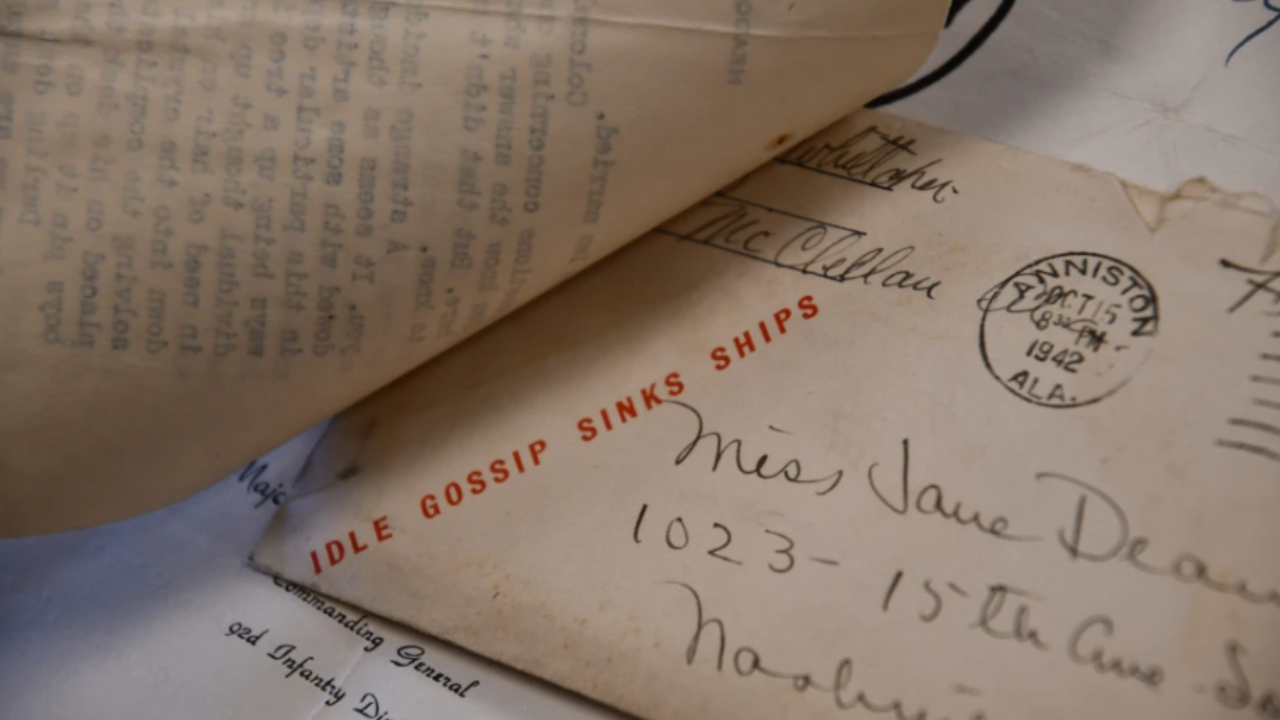
©(AP Photo/Kristin M. Hall)
Pre-reading Questions:
I will read each question. Then, please answer them.
- Why do people keep old letters, photos, or messages from the past?
- If you found letters from people who lived long ago, what would you want to learn about them?
Vocabulary:
I will read the words, meanings, and sample sentences. Then, repeat after me.
- conflict /kuhn-FLIKT/
[noun] – a serious disagreement or fight between groups or countries
The conflict between the two teams delayed the project. - insight /IN-sahyt/
[noun] – a clear understanding of a situation or idea
The survey provides insight into customer behavior. - wartime /WAWR-tahym/
[adjective] – relating to a period when a war is happening
The museum shows wartime rules for daily life. - accessible /ak-SES-uh-buhl/
[adjective] – easy for people to reach, use, or understand
The website is accessible to users with different devices. - digitization /dij-it-ahyz-AY-shuhn/
[noun] – the process of changing information into digital form
Digitization helps schools store records safely.
Article Reading:
Please read the whole article. Then, I will check your pronunciation and intonation.
A digital collection of World War II love letters is now available through the Nashville Public Library. The collection includes more than 200 letters written between 1942 and 1945 by William Raymond Whittaker and Jane Dean, who had strong ties to Nashville through education and work. The letters were found in a family home and donated in 2016 to the Metro Nashville Archives, which now manages the materials. The correspondence shows how the couple began their relationship at Meharry Medical College and continued to communicate after military service separated them. Archivists state that the collection helps preserve personal history from a major global conflict and offers insight into daily life during wartime America, including the effects of segregation and military service.
The digital exhibit explains how archivists carefully organized, scanned, and described each letter to make the collection accessible while protecting the original documents. Staff members report that modern digitization tools allowed the archive to present the materials without damaging fragile paper. The project also faced challenges, such as limited background information and the lack of living relatives, which required close study of the letters themselves. Library officials note that online access allows students, educators, and researchers around the world to explore the collection and better understand social history during the 1940s.
The digital exhibit explains how archivists carefully organized, scanned, and described each letter to make the collection accessible while protecting the original documents. Staff members report that modern digitization tools allowed the archive to present the materials without damaging fragile paper. The project also faced challenges, such as limited background information and the lack of living relatives, which required close study of the letters themselves. Library officials note that online access allows students, educators, and researchers around the world to explore the collection and better understand social history during the 1940s.
Comprehension Questions:
I will read each question. Then, please answer them based on the article.
- What is now available through the Nashville Public Library?
- How many love letters are included in the collection?
- When were the letters written?
- Why did archivists scan and organize the letters?
- Who can explore the collection through online access?
Discussion Questions:
I will read each question. Then, please answer them.
- Have you ever kept old letters, cards, or messages from someone? If so, why did you keep them? If not, what kind of messages would you like to keep in the future?
- Have you ever talked to someone who lived far away? If so, how did you communicate with that person? If not, how would you like to communicate with someone far away?
- Do you agree that old letters can help people understand daily life in the past?
- What problems might archivists face when protecting old letters?
- What can people today learn from couples who lived during wartime?