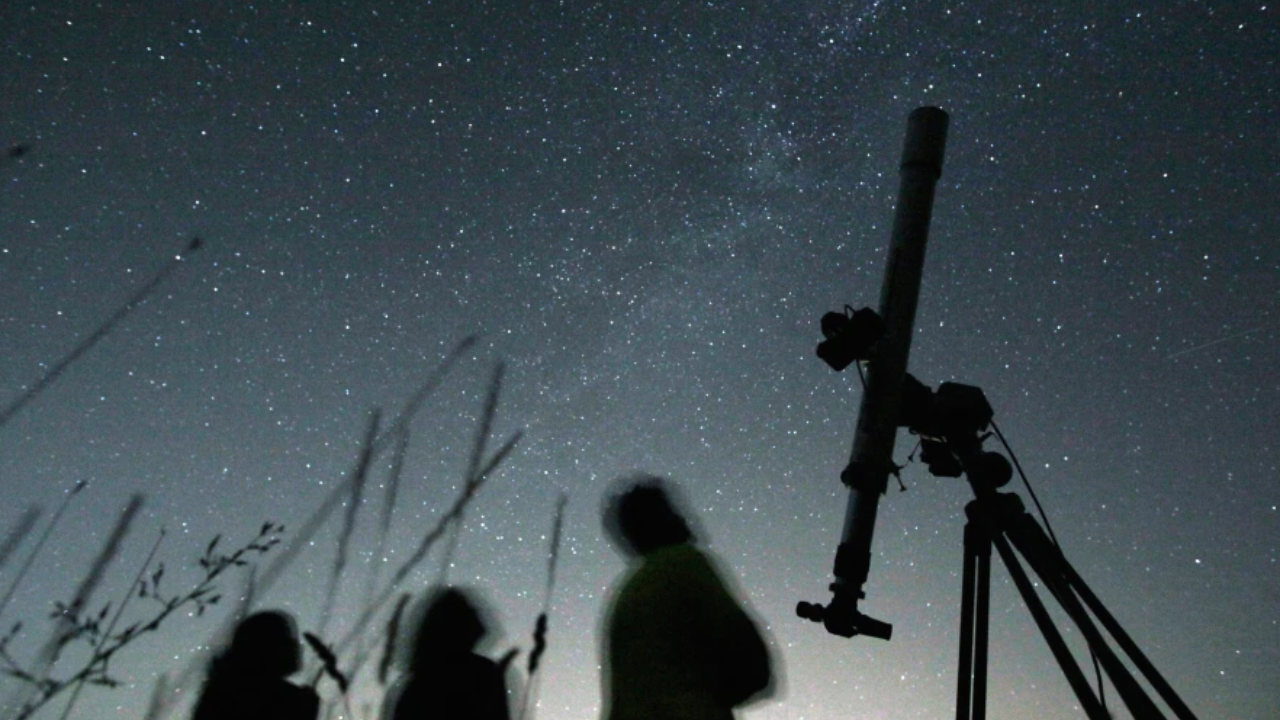
©AP Photo/Petar Petrov, File
Vocabulary:
I will read the words, meanings, and sample sentences. Then, repeat after me.
- alignment /uh-LAHYN-muhnt/
[noun] – an arrangement in which two or more things are positioned in a straight line or in agreement
The alignment of the chairs created a neat and orderly space. - celestial /suh-LES-chuhl/
[adjective] – relating to the sky or outer space
Astronomers study celestial objects such as stars and planets. - phenomenon /fi-NOM-uh-non/
[noun] – something that exists and can be seen, felt, tasted, etc., especially something unusual or interesting
The northern lights are a natural phenomenon seen in cold regions. - horizon /huh-RAHY-zuhn/
[noun] – the line at the far distance where the sky seems to meet the land or the sea
The sun slowly disappeared below the horizon at dusk. - astronomical /as-truh-NOM-i-kuhl/
[adjective] – relating to astronomy
The telescope provided detailed astronomical observations.
Article Reading:
Please read the whole article. Then, I will check your pronunciation and intonation.
Six planets appeared in a rare alignment at the end of February, creating a striking celestial display visible across much of the world. The event, commonly called a planetary parade, occurred when several planets gathered on one side of the sun and seemed to line up in the evening sky. Although not arranged in a perfectly straight line, the grouping formed an impressive visual cluster shortly after sunset. According to NASA, such a phenomenon involving six planets visible at once is uncommon and draws significant interest from both scientists and the public.
Observers stepped outside about an hour after sunset and faced the western sky near the horizon, away from buildings and trees that could obstruct the view. Mercury, Venus, Jupiter and Saturn were visible without equipment under clear conditions, while Uranus and Neptune required binoculars or telescopes. Experts noted that planets shine steadily, unlike stars that typically twinkle. Planetary scientist Sara Mazrouei of Humber Polytechnic in Canada explained that the steady light helped distinguish planets from surrounding stars. The display continued over several days before Mercury gradually dipped below the horizon. Scientists described the event as both educational and inspiring, linking modern viewers to centuries of astronomical observation conducted simply by watching the night sky.
Observers stepped outside about an hour after sunset and faced the western sky near the horizon, away from buildings and trees that could obstruct the view. Mercury, Venus, Jupiter and Saturn were visible without equipment under clear conditions, while Uranus and Neptune required binoculars or telescopes. Experts noted that planets shine steadily, unlike stars that typically twinkle. Planetary scientist Sara Mazrouei of Humber Polytechnic in Canada explained that the steady light helped distinguish planets from surrounding stars. The display continued over several days before Mercury gradually dipped below the horizon. Scientists described the event as both educational and inspiring, linking modern viewers to centuries of astronomical observation conducted simply by watching the night sky.
Discussion Questions:
I will read each question. Then, please answer them.
- Have you ever observed a rare sky event? If so, what did it feel like? If not, would such an experience be interesting?
- Have you ever used binoculars or a telescope to view planets? If so, what was visible? If not, would trying it be appealing?
- Do you agree that events like planetary alignments increase public interest in science?
- What makes sky observations meaningful for communities today?
- How might regular observation of the night sky influence scientific curiosity in future generations?
Summarization:
Please summarize the whole article using your own words and expressions. You will have one minute to prepare before you answer.
Describe:
Please explain the definition of each word listed below based on your understanding. You can provide example sentences if needed.
- appear
- display
- uncommon
- telescope
- gradually