©Gabor Lakos, Budapest History Museum via AP
Vocabulary:
I will read the words, meanings, and sample sentences. Then, repeat after me.
- unearth /uhn-URTH/
[verb] – to discover something that has been buried in the ground
Archaeologists unearthed ancient tools during the excavation. - hermetically /hur-MET-ik-lee/
[adverb] – in a way that is completely closed so that no air can enter or escape
The container was hermetically sealed to protect the contents. - artifact /AHR-tuh-fakt/
[noun] – an object made by humans in the past, especially those of historical or cultural interest
The museum displayed artifacts from an early civilization. - repurpose /ree-PUR-puhs/
[verb] – to use something for a different purpose from the one originally intended
Old buildings were repurposed into cultural centers. - abundance /uh-BUHN-duhns/
[noun] – a very large quantity of something
The region has an abundance of historical monuments.
Article Reading:
Please read the whole article. Then, I will check your pronunciation and intonation.
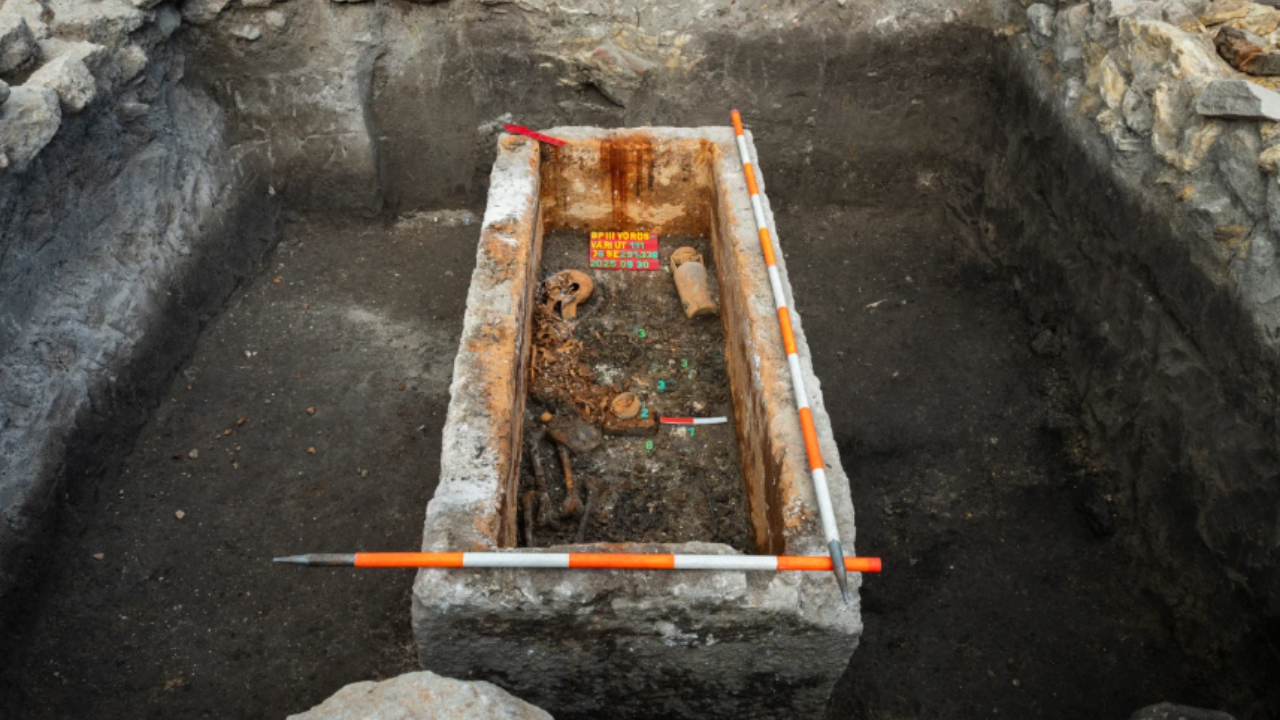
A remarkably well-preserved Roman sarcophagus was unearthed during a major archaeological excavation in Budapest, Hungary, offering new insight into burial practices and social life along the ancient Danube frontier around 1,700 years ago. The limestone coffin was discovered in the northern district of Óbuda, once part of Aquincum, a Roman settlement that flourished along the empire’s frontier. Archaeologists from the Budapest History Museum reported that the coffin remained hermetically sealed beneath its stone lid, secured with metal clamps and molten lead. When researchers carefully opened the tomb, a complete skeleton and dozens of valuable artifacts were revealed, including glass vessels, bronze figures, and more than one hundred Roman coins. The unusual state of preservation and intact burial arrangement has drawn particular attention from specialists studying the region’s Roman-era communities.
The sarcophagus lay within the remains of an abandoned neighborhood that had been repurposed as a burial ground during the third century. Nearby excavations uncovered a Roman aqueduct and several simpler graves, yet none displayed comparable preservation or richness. Archaeologists believe the objects placed beside the deceased formed part of traditional funerary offerings intended for the afterlife. Anthropologists will analyze the skeleton to determine age, health and possible origins. Even before laboratory results emerge, the grave’s placement and the abundance of objects strongly suggest that the woman belonged to a prosperous or influential family connected to the nearby Roman military settlement.
The sarcophagus lay within the remains of an abandoned neighborhood that had been repurposed as a burial ground during the third century. Nearby excavations uncovered a Roman aqueduct and several simpler graves, yet none displayed comparable preservation or richness. Archaeologists believe the objects placed beside the deceased formed part of traditional funerary offerings intended for the afterlife. Anthropologists will analyze the skeleton to determine age, health and possible origins. Even before laboratory results emerge, the grave’s placement and the abundance of objects strongly suggest that the woman belonged to a prosperous or influential family connected to the nearby Roman military settlement.
Discussion Questions:
I will read each question. Then, please answer them.
- Have you ever visited an archaeological site? If so, what was the experience like? If not, would visiting one be interesting?
- Have you ever seen ancient artifacts in a museum? If so, which objects were most memorable? If not, which historical items would be most interesting to see?
- Do you agree that preserving ancient burial sites is important for understanding history?
- Why might ancient people place objects inside tombs or graves?
- How can archaeological discoveries change modern understanding of ancient societies?
Summarization:
Please summarize the whole article using your own words and expressions. You will have one minute to prepare before you answer.
Describe:
Please explain the definition of each word listed below based on your understanding. You can provide example sentences if needed.
- excavation
- discover
- tomb
- anthropologist
- influential