©JHU/APL, NASA via AP
Vocabulary:
I will read the words, meanings, and sample sentences. Then, repeat after me.
- plunge /PLUHNJ/
[verb] – to fall suddenly and quickly from a high position
The aircraft plunged into the ocean during a storm. - orbit /OR-bit/
[noun] – the curved path that a spacecraft follows around a planet
The satellite stayed in orbit for several years. - reentry /ree-EN-tree/
[noun] – the act of returning to Earth’s atmosphere from space
The capsule made a safe reentry after the mission. - radiation /ray-dee-AY-shuhn/
[noun] – energy in the form of waves that can be harmful to living things
Scientists study radiation to understand space conditions. - eccentric /ik-SEN-trik/
[adjective] – strange or unusual in behavior or appearance
The comet followed an eccentric path around the sun.
Article Reading:
Please read the whole article. Then, I will check your pronunciation and intonation.
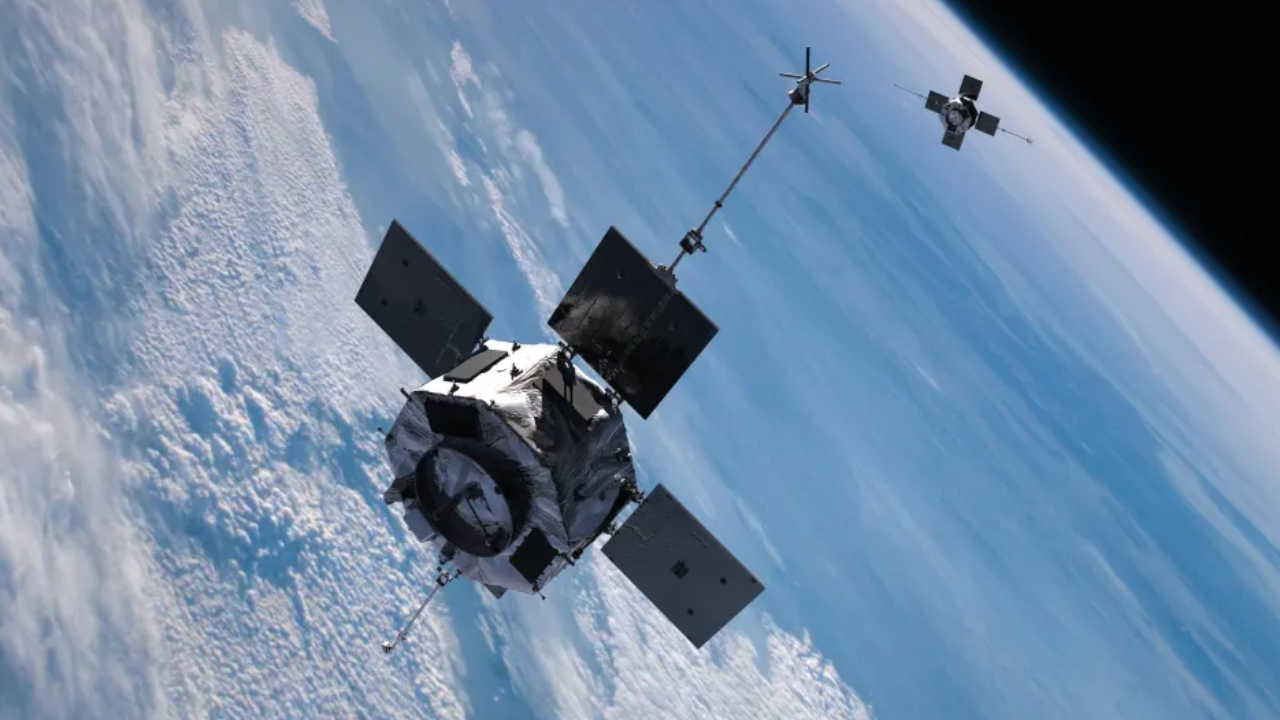
An aging NASA science satellite made a sudden plunge from orbit on Wednesday, completing an uncontrolled reentry over the Pacific Ocean west of the Galapagos Islands. The U.S. Space Force confirmed that the spacecraft, known as Van Allen Probe A, returned to Earth after years of operation studying powerful radiation belts surrounding the planet. The satellite originally launched in 2012 as part of a twin mission designed to improve understanding of space radiation and its effects on technology and astronauts. NASA estimated that small fragments of the 1,323-pound spacecraft could survive the fiery descent through the atmosphere, although most components were expected to burn up during reentry. Officials also calculated that the statistical risk of bodily harm on the ground remained extremely low.
Van Allen Probe A spent seven years examining the dynamic radiation environment encircling Earth before operations ended in 2019 when fuel supplies were exhausted. NASA initially expected the spacecraft to remain in orbit until approximately 2034, but heightened solar activity in recent years accelerated orbital decay and ultimately led to the probe’s earlier plunge. Its twin spacecraft, Van Allen Probe B, continues circling Earth although it is no longer operational. Scientists involved in orbital tracking explained that predicting spacecraft reentry can be difficult because atmospheric conditions constantly change. Dutch scientist Marco Langbroek noted that this particular case proved especially challenging due to the satellite’s eccentric, lopsided orbit, which complicated calculations and narrowed the time window for predicting the precise location of atmospheric descent.
Van Allen Probe A spent seven years examining the dynamic radiation environment encircling Earth before operations ended in 2019 when fuel supplies were exhausted. NASA initially expected the spacecraft to remain in orbit until approximately 2034, but heightened solar activity in recent years accelerated orbital decay and ultimately led to the probe’s earlier plunge. Its twin spacecraft, Van Allen Probe B, continues circling Earth although it is no longer operational. Scientists involved in orbital tracking explained that predicting spacecraft reentry can be difficult because atmospheric conditions constantly change. Dutch scientist Marco Langbroek noted that this particular case proved especially challenging due to the satellite’s eccentric, lopsided orbit, which complicated calculations and narrowed the time window for predicting the precise location of atmospheric descent.
Discussion Questions:
I will read each question. Then, please answer them.
- Have you ever watched a satellite launch or space mission news? If so, what did you learn? If not, would such events be interesting to follow?
- Have you ever studied space science or astronomy? If so, what topic interested you most? If not, what topic might be interesting to learn?
- Do you agree that studying space environments is important for modern technology and communication?
- What role should governments play in monitoring satellites and space debris around Earth?
- How might increasing numbers of satellites affect future space exploration and safety?
Summarization:
Please summarize the whole article using your own words and expressions. You will have one minute to prepare before you answer.
Describe:
Please explain the definition of each word listed below based on your understanding. You can provide example sentences if needed.
- spacecraft
- launch
- radiation
- constantly
- descent