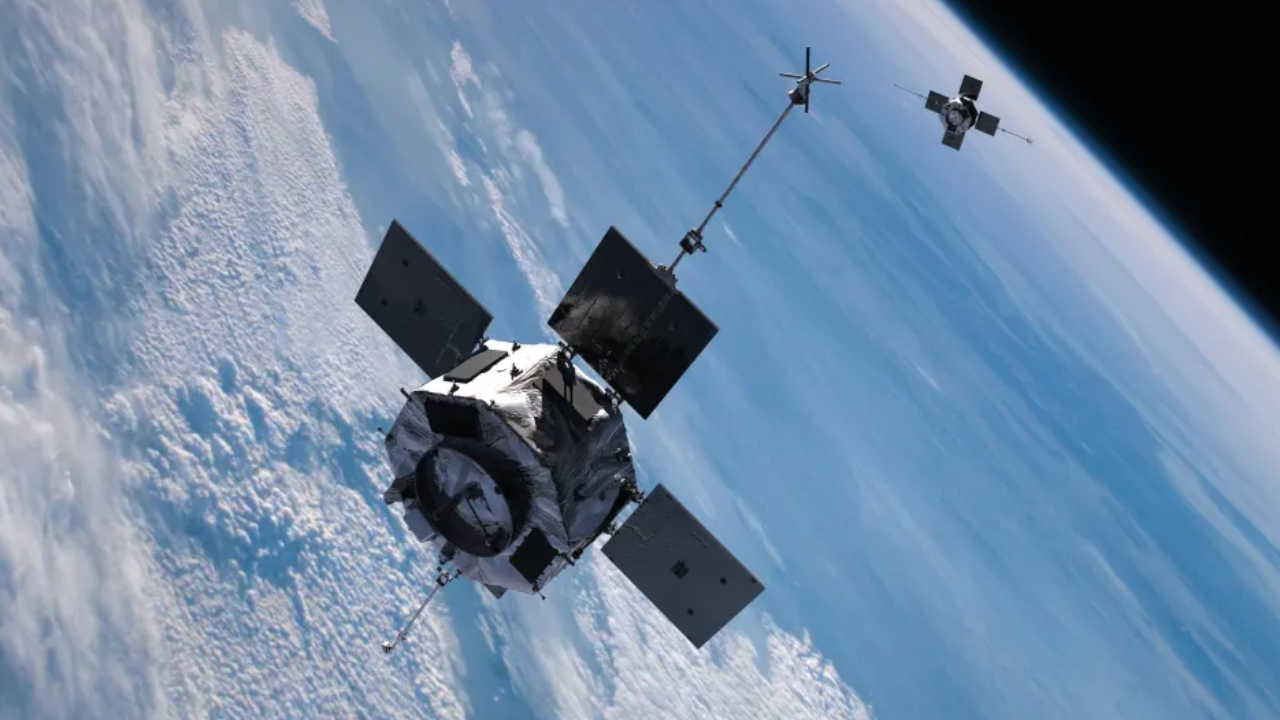
©JHU/APL, NASA via AP
Pre-reading Questions:
I will read each question. Then, please answer them.
- What do satellites do in space?
- Why do scientists study space around Earth?
Vocabulary:
I will read the words, meanings, and sample sentences. Then, repeat after me.
- satellite /SAT-l-ahyt/
[noun] – a machine sent into space to travel around Earth and collect information
The satellite sends weather images to scientists. - descent /dih-SENT/
[noun] – the act of moving down from a higher place
The capsule began its slow descent toward Earth. - probe /prohb/
[noun] – a spacecraft sent to collect information about space
The probe traveled far from Earth to study planets. - atmosphere /AT-muhs-feer/
[noun] – the layer of gases surrounding Earth
The atmosphere protects Earth from harmful radiation. - predict /prih-DIKT/
[verb] – to say what will happen in the future
Scientists predict weather changes using data.
Article Reading:
Please read the whole article. Then, I will check your pronunciation and intonation.
An old NASA satellite returned to Earth on Wednesday after falling from space in an uncontrolled descent over the Pacific Ocean west of the Galapagos Islands. The U.S. Space Force reported that the spacecraft, called Van Allen Probe A, reentered the atmosphere after spending years studying the dangerous radiation belts surrounding Earth. NASA said the 1,323-pound satellite was expected to break apart during its descent, with most pieces burning up in the atmosphere. Officials also estimated that the risk of anyone being injured on the ground was extremely small.
The satellite was part of a pair of probes launched in 2012 to explore how radiation affects spacecraft and astronauts. Both satellites studied the Van Allen belts for seven years before their missions ended in 2019 after running out of fuel. Scientists originally predicted that the spacecraft would stay in orbit until around 2034. However, strong solar activity in recent years caused the satellite to fall earlier than expected. The second satellite, Van Allen Probe B, is still traveling around Earth but no longer working. Experts say predicting satellite reentry can be difficult because the spacecraft followed an unusual and uneven orbit around the planet.
The satellite was part of a pair of probes launched in 2012 to explore how radiation affects spacecraft and astronauts. Both satellites studied the Van Allen belts for seven years before their missions ended in 2019 after running out of fuel. Scientists originally predicted that the spacecraft would stay in orbit until around 2034. However, strong solar activity in recent years caused the satellite to fall earlier than expected. The second satellite, Van Allen Probe B, is still traveling around Earth but no longer working. Experts say predicting satellite reentry can be difficult because the spacecraft followed an unusual and uneven orbit around the planet.
Comprehension Questions:
I will read each question. Then, please answer them based on the article.
- Where did the satellite return to Earth?
- What was the name of the satellite that reentered the atmosphere?
- What did the satellite study during its mission?
- When were the two probes launched?
- Why did the satellite fall earlier than scientists expected?
Discussion Questions:
I will read each question. Then, please answer them.
- Have you ever read news about satellites or space missions? If so, what did the report say? If not, would such news be interesting to read?
- Have ypu ever seen a rocket launch on television or online? If so, how did it look? If not, would you like to watch one?
- Do you agree that governments should carefully monitor satellites in space?
- What benefits do satellites give to everyday life on Earth?
- Why might scientists want to study radiation in space?