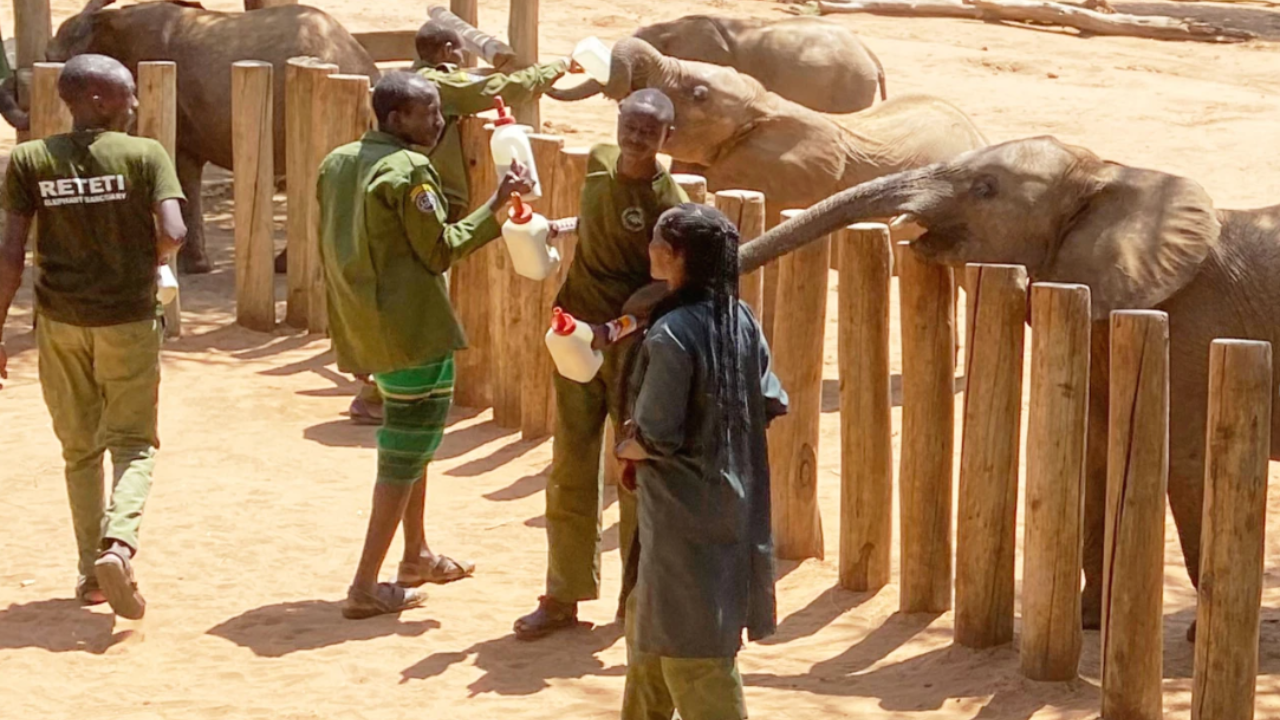
©John Dowling via AP
Vocabulary:
I will read the words, meanings, and sample sentences. Then, repeat after me.
- paradigm shift //PAIR-uh-dime SHIFT//
[noun phrase] – a significant change in ideas, methods, or systems
The sanctuary represents a paradigm shift in how wildlife conservation is managed. - innovative /IN-uh-vay-tiv/
[adjective] – introducing new ideas or methods
The sanctuary used an innovative feeding strategy for elephants. - integral /IN-ti-gruhl/
[adjective] – necessary and important as part of a whole
Elephants are integral to the region’s ecosystem. - sustainable /suh-STAY-nuh-buhl/
[adjective] – able to continue without harming resources
Sustainable tourism supports long-term development. - replicable /REP-li-kuh-buhl/
[adjective] – able to be repeated or copied successfully
Experts believe the model is replicable elsewhere.
Article Reading:
Please read the whole article. Then, I will check your pronunciation and intonation.
A Kenyan elephant sanctuary has drawn international attention for combining wildlife rescue with Indigenous-led economic development, highlighting how conservation and community welfare can advance together. In 2025, Reteti Elephant Sanctuary, located in northern Kenya, continued caring for orphaned elephants while creating sustainable income for local Samburu residents. The sanctuary operates in a remote, arid region where elephants are often separated from families because of drought, human conflict, or environmental disruption. Conservation specialists say Reteti represents a paradigm shift by placing Indigenous leadership at the center of animal protection rather than relying on external organizations alone.
Reteti rescues young elephants reported by villagers and provides daily care until the animals can be returned to the wild. A key challenge involved feeding the orphans, as commercial formulas proved expensive and nutritionally ineffective. Caretakers identified goat’s milk as a viable alternative, sourcing it locally from Samburu families. This innovative solution supports elephant health while strengthening household income, particularly for women. More than a thousand Samburu women now sell milk to the sanctuary, improving food security and financial autonomy. Reteti also employs around one hundred local residents and remains the only elephant sanctuary in Africa fully managed by Indigenous people. Conservation leaders describe elephants as an integral component of both the ecosystem and regional economy. Tourism partners emphasize that respectful travel can create sustainable benefits when profits are reinvested locally. Supporters argue that Reteti demonstrates how conservation can be replicable across Africa when communities are empowered rather than displaced.
Reteti rescues young elephants reported by villagers and provides daily care until the animals can be returned to the wild. A key challenge involved feeding the orphans, as commercial formulas proved expensive and nutritionally ineffective. Caretakers identified goat’s milk as a viable alternative, sourcing it locally from Samburu families. This innovative solution supports elephant health while strengthening household income, particularly for women. More than a thousand Samburu women now sell milk to the sanctuary, improving food security and financial autonomy. Reteti also employs around one hundred local residents and remains the only elephant sanctuary in Africa fully managed by Indigenous people. Conservation leaders describe elephants as an integral component of both the ecosystem and regional economy. Tourism partners emphasize that respectful travel can create sustainable benefits when profits are reinvested locally. Supporters argue that Reteti demonstrates how conservation can be replicable across Africa when communities are empowered rather than displaced.
Discussion Questions:
I will read each question. Then, please answer them.
- What community-led projects have been seen in the area, if any? If so, what impact was observed? If not, what projects could be introduced?
- What conservation challenges have been noticed locally, if any? If so, how were they addressed? If not, what actions could help?
- Do community-run sanctuaries work better than foreign-led projects?
- Should tourism profits always support local residents?
- Can this model succeed in areas with less tourism?
Summarization:
Please summarize the whole article using your own words and expressions. You will have one minute to prepare before you answer.
Describe:
Please explain the definition of each word listed below based on your understanding. You can provide example sentences if needed.
- conversation
- specialist
- leadership
- component
- demonstrate