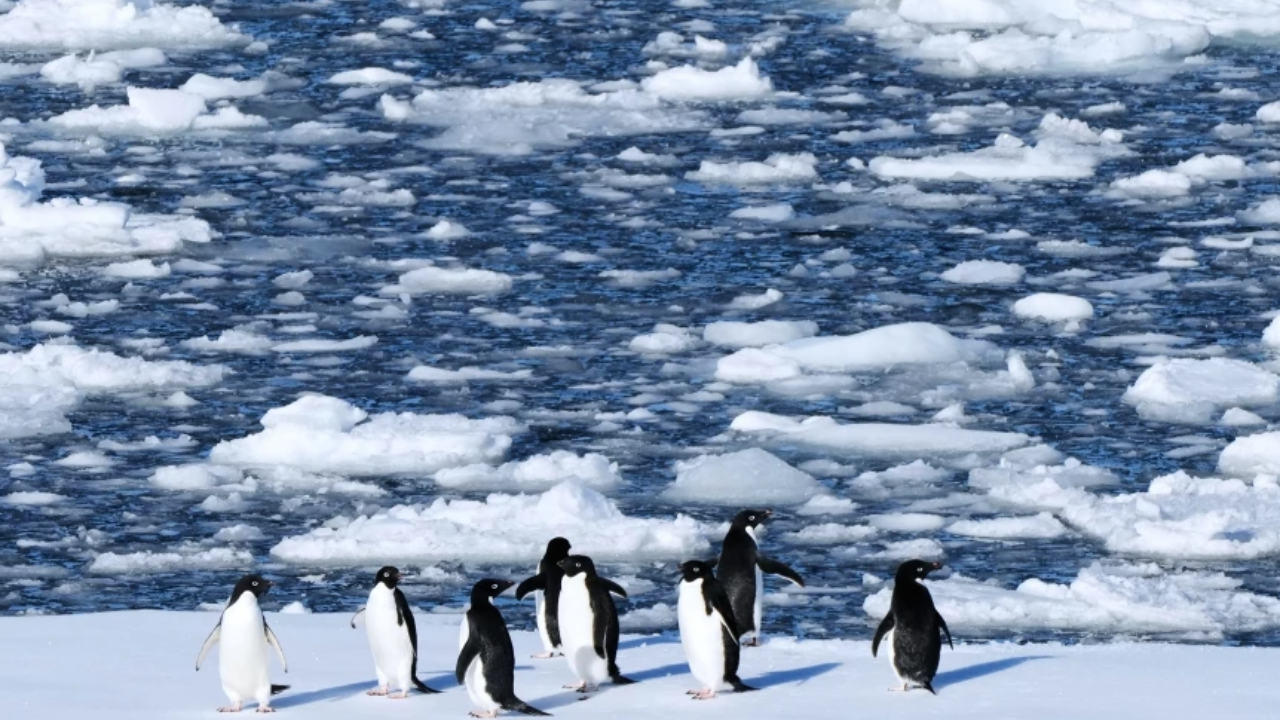
©AP Photo/Mark Baker, File
Vocabulary:
I will read the words, meanings, and sample sentences. Then, repeat after me.
- unprecedented /uhn-PRES-i-den-tid/
[adjective] – never done or known before
The speed of environmental change was unprecedented in the region. - comprehensive /kom-pri-HEN-siv/
[adjective] – including all or nearly all elements
Researchers conducted a comprehensive review of breeding data. - disproportionate /dis-pruh-PAWR-shush-nit/
[adjective] – too large or too small in comparison
Gentoo penguins gained a disproportionate advantage. - vulnerability /vuhl-ner-uh-BIL-i-tee/
[noun] – the state of being exposed to harm
Climate shifts increased the vulnerability of specialists. - monitoring /MON-i-ter-ing/
[noun] – observing and checking over time
Monitoring helped identify long-term trends.
Article Reading:
Please read the whole article. Then, I will check your pronunciation and intonation.
Warming conditions across Antarctica are forcing penguin species to adjust breeding schedules earlier than previously observed, raising concerns about long-term population stability, according to a recent scientific study. Data collected from multiple breeding sites show that rising temperatures have altered seasonal food availability, increasing risks for species whose reproductive timing depends on precise environmental cues. Researchers reported that Adélie, chinstrap, and gentoo penguins now begin nesting earlier in the year, a shift described as unprecedented among vertebrate animals. Scientists warned that such rapid change may undermine chick survival, particularly for species reliant on narrow feeding windows.
The study relied on a comprehensive network of remote cameras that documented breeding activity over a ten-year period, allowing researchers to track changes with exceptional accuracy. Analysis revealed that warming has reduced sea ice earlier in the season, triggering earlier phytoplankton growth and altering krill distribution. This shift has produced a disproportionate advantage for gentoo penguins, whose flexible diets and shorter migration routes allow faster adaptation. In contrast, chinstrap and Adélie penguins face increasing vulnerability due to limited food options and heightened competition. Scientists emphasized that continued monitoring remains essential as commercial fishing activity expands earlier in the year, further straining food supplies. Experts noted that breeding disruption serves as a critical indicator of broader ecosystem change, signaling that Antarctic wildlife is responding to climate pressure at an accelerating pace. Without targeted conservation efforts, population decline among specialized species is expected to intensify before the end of the century.
The study relied on a comprehensive network of remote cameras that documented breeding activity over a ten-year period, allowing researchers to track changes with exceptional accuracy. Analysis revealed that warming has reduced sea ice earlier in the season, triggering earlier phytoplankton growth and altering krill distribution. This shift has produced a disproportionate advantage for gentoo penguins, whose flexible diets and shorter migration routes allow faster adaptation. In contrast, chinstrap and Adélie penguins face increasing vulnerability due to limited food options and heightened competition. Scientists emphasized that continued monitoring remains essential as commercial fishing activity expands earlier in the year, further straining food supplies. Experts noted that breeding disruption serves as a critical indicator of broader ecosystem change, signaling that Antarctic wildlife is responding to climate pressure at an accelerating pace. Without targeted conservation efforts, population decline among specialized species is expected to intensify before the end of the century.
Discussion Questions:
I will read each question. Then, please answer them.
- What environmental changes have been seen in the community, if any? If so, what effects were noticed? If not, what changes are expected?
- What wildlife shifts have been seen in nearby areas, if any? If so, how were they observed? If not, why might observation be limited?
- Should climate indicators in wildlife be treated as urgent warnings?
- How could conservation strategies adapt to rapid environmental change?
- Why might species flexibility determine survival outcomes?
Summarization:
Please summarize the whole article using your own words and expressions. You will have one minute to prepare before you answer.
Describe:
Please explain the definition of each word listed below based on your understanding. You can provide example sentences if needed.
- condition
- population
- reproductive
- track
- decline