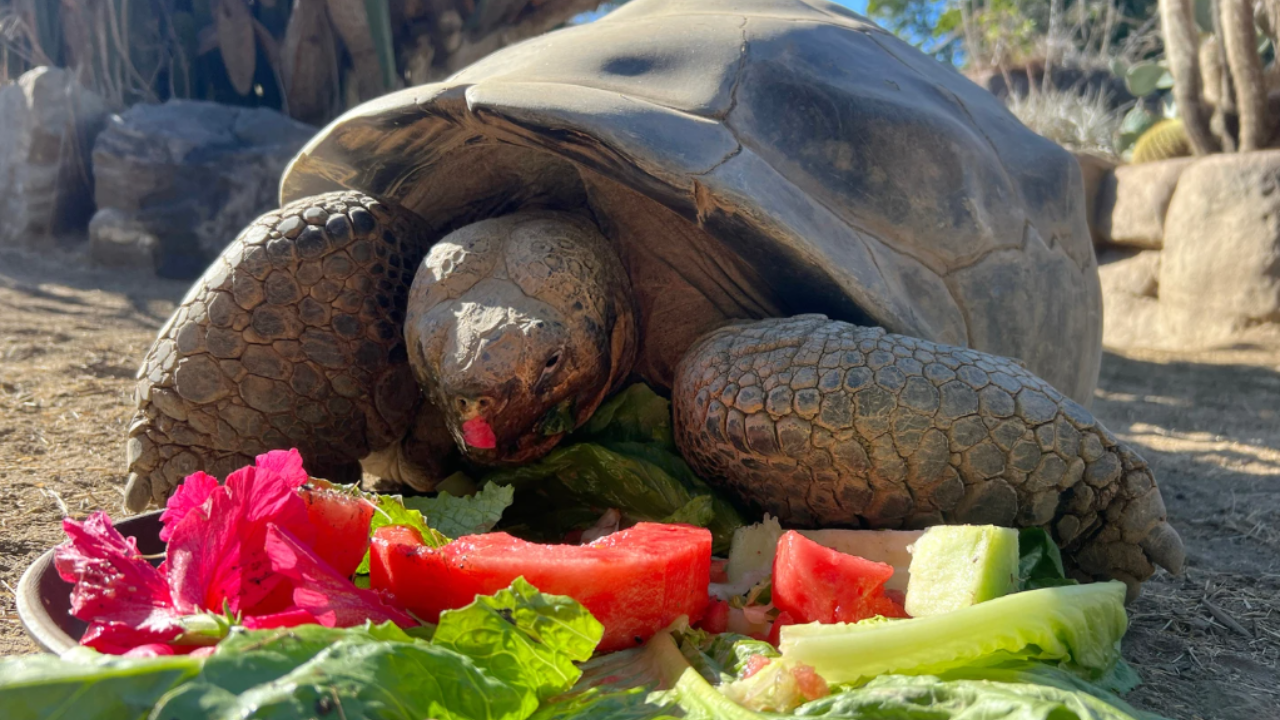
©(San Diego Zoo Wildlife Alliance via AP)
Vocabulary:
I will read the words, meanings, and sample sentences. Then, repeat after me.
- euthanasia /yoo-thuh-NEY-zhuh/
[noun] – the act of ending the life of an animal or person to stop severe pain or suffering
The shelter explained that euthanasia is used only when an animal cannot recover and is suffering deeply. - emblematic /em-bluh-MAT-ik/
[adjective] – representing or symbolizing an important idea or quality
The old lighthouse became emblematic of the town’s long history by the sea. - longevity /lon-JEV-i-tee/
[noun] – long life or the ability to live for a long time
Scientists study the longevity of certain trees that can live for hundreds of years. - skeletal /SKEL-i-tl/
[adjective] – related to bones or the structure of bones in a body
The museum displayed the skeletal remains of ancient animals for visitors to study. - subspecies /SUHB-spee-sheez/
[noun] – a group within a species that has distinct characteristics but can still reproduce with the main species
The national park is home to several subspecies of deer that live in different habitats.
Article Reading:
Please read the whole article. Then, I will check your pronunciation and intonation.
A long-lived Galápagos tortoise named Gramma died at the San Diego Zoo on November 20, 2025, after an estimated lifespan of about 141 years. Zoo records showed that the tortoise originally came from the Galápagos Islands and later arrived from the Bronx Zoo, possibly in 1928 or 1931, as part of an early conservation group. Gramma lived through major historical periods, including two global wars and the terms of 20 United States presidents. Zoo specialists stated that the animal developed serious age-related bone conditions that recently worsened, leading to euthanasia. Many visitors shared memories of early encounters with the tortoise, and several longtime guests described Gramma as a symbol of endurance and natural heritage. Experts explained that Galápagos tortoises usually live for more than 100 years in the wild and can reach close to double that age in human care, making this species an emblematic example of extreme longevity.
Veterinarians reported that Gramma received specialized support during the final stage of life, including monitoring for skeletal changes that often affect elderly tortoises. The zoo also highlighted the wider conservation context, noting that Galápagos tortoises consist of 15 subspecies, with three considered extinct and the rest classified as vulnerable or critically endangered by the International Union for Conservation of Nature. Breeding programs have released more than 10,000 juveniles into natural habitats since 1965, demonstrating a significant and deliberate effort to restore declining populations. Recent hatchings at the Philadelphia Zoo and Zoo Miami showed continued reproductive success among extremely old adults, a development viewed as encouraging for future recovery. Scientists emphasized that ongoing protection, genetic research, and habitat management remain crucial for long-term species survival, despite persistent ecological threats and habitat fragmentation.
Veterinarians reported that Gramma received specialized support during the final stage of life, including monitoring for skeletal changes that often affect elderly tortoises. The zoo also highlighted the wider conservation context, noting that Galápagos tortoises consist of 15 subspecies, with three considered extinct and the rest classified as vulnerable or critically endangered by the International Union for Conservation of Nature. Breeding programs have released more than 10,000 juveniles into natural habitats since 1965, demonstrating a significant and deliberate effort to restore declining populations. Recent hatchings at the Philadelphia Zoo and Zoo Miami showed continued reproductive success among extremely old adults, a development viewed as encouraging for future recovery. Scientists emphasized that ongoing protection, genetic research, and habitat management remain crucial for long-term species survival, despite persistent ecological threats and habitat fragmentation.
Discussion Questions:
I will read each question. Then, please answer them.
- Have you ever visited a zoo or a wildlife park? If so, what was the most memorable animal you saw, and why did it stand out to you? If not, what animal would you like to see in a zoo, and why?
- Have you ever learned about an animal that can live a very long time? If so, what did you find interesting about it? If not, which long-lived animal would you like to learn more about?
- Do you agree that protecting animal habitats is just as important as caring for animals in zoos?
- Why do you think some animals, such as Galápagos tortoises, live much longer in human care than in the wild?
- What challenges do you think zoos face when trying to protect endangered species with very long lifespans?
Summarization:
Please summarize the whole article using your own words and expressions. You will have one minute to prepare before you answer.
Describe:
Please explain the definition of each word listed below based on your understanding. You can provide example sentences if needed.
- zoo
- conservation
- historical period
- heritage
- human care