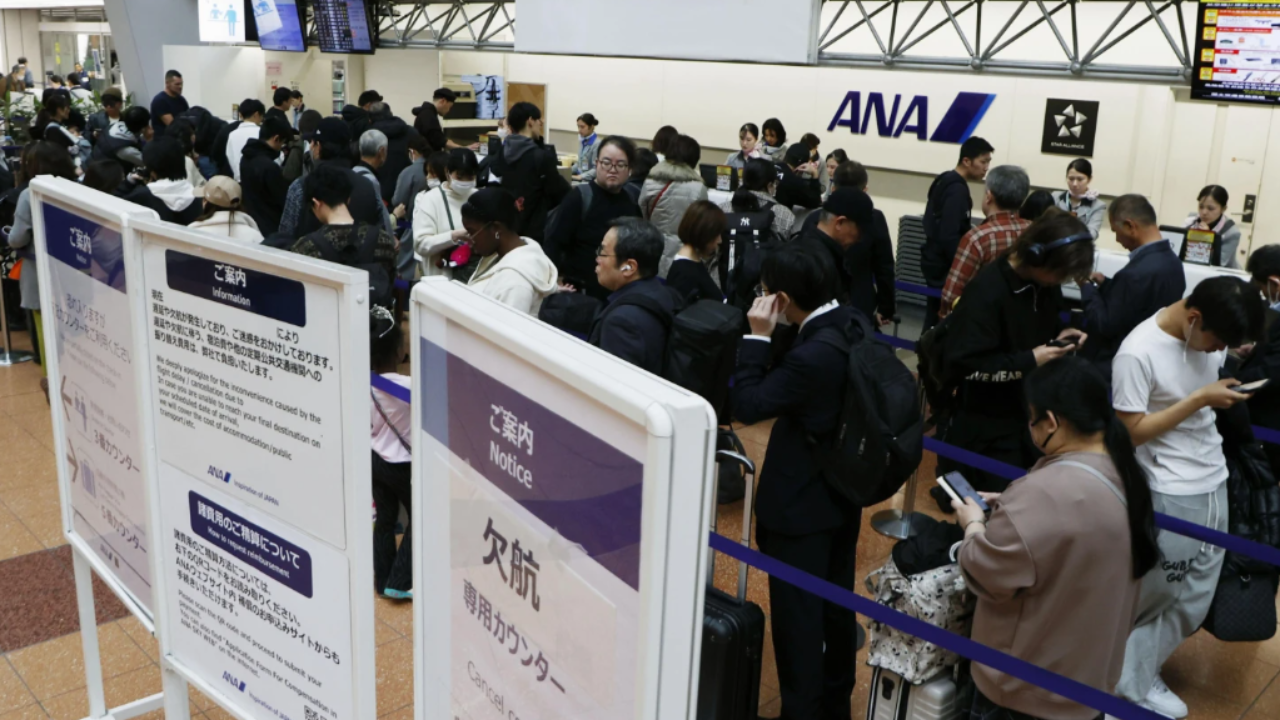
©(Takahiko Kanbara/Kyodo News via AP)
Vocabulary:
I will read the words, meanings, and sample sentences. Then, repeat after me.
- divert /dih-VURT/
[verb] – to change direction or to make something go to a different place
The train was diverted to another station because of heavy flooding on the tracks. - scrutiny /SKROOT-n-ee/
[noun] – careful and detailed examination
The new city budget came under scrutiny after residents questioned several spending choices. - interval /IN-ter-vuhl/
[noun] – a period of time between events
Buses arrived at regular intervals throughout the afternoon to manage the holiday crowds. - resilience /ri-ZIL-yuhns/
[noun] – the ability to recover quickly from difficulties
The company demonstrated resilience by continuing operations despite economic challenges. - rectification /rek-tuh-fi-KEY-shuhn/
[noun] – the act of correcting something
The team completed the rectification of an error in the financial report before submitting it again.
Article Reading:
Please read the whole article. Then, I will check your pronunciation and intonation.
Airlines in several regions began canceling and delaying flights on 29 November 2025 after aviation authorities identified a software problem affecting Airbus A320-family aircraft. The investigation followed an incident on 30 October 2025, when a JetBlue flight from Cancun to Newark experienced a sudden altitude drop and diverted to Tampa. Technical reviews indicated that strong solar radiation may have corrupted data in the flight control system after a recent software update. Aviation agencies ordered a corrective update for more than 500 aircraft registered in the United States. The situation intensified pressure on carriers because the period after the Thanksgiving holiday is traditionally the busiest travel season. Airlines in Japan, Europe, India, and the United States prepared for temporary disruptions as engineers worked to address the malfunction with greater scrutiny.
Most carriers stated that the update could be completed during routine maintenance intervals, such as overnight inspections or short breaks between flights. American Airlines reported that more than 200 aircraft required the reset, while All Nippon Airways canceled 65 domestic flights and warned that additional delays might occur. Delta, United, and Air India described limited operational impact, and Hawaiian Airlines confirmed that no aircraft in its fleet were affected. Aviation specialists explained that the A320 family is widely used and plays a major role in global travel. Experts stated that the situation emphasized the need for strong technological resilience in digital systems. Analysts added that effective mitigation helps reduce risks linked to environmental interference. Industry observers noted that operational continuity remains important during large-scale software adjustments. Additional commentary highlighted that timely rectification supports long-term aviation safety.
Most carriers stated that the update could be completed during routine maintenance intervals, such as overnight inspections or short breaks between flights. American Airlines reported that more than 200 aircraft required the reset, while All Nippon Airways canceled 65 domestic flights and warned that additional delays might occur. Delta, United, and Air India described limited operational impact, and Hawaiian Airlines confirmed that no aircraft in its fleet were affected. Aviation specialists explained that the A320 family is widely used and plays a major role in global travel. Experts stated that the situation emphasized the need for strong technological resilience in digital systems. Analysts added that effective mitigation helps reduce risks linked to environmental interference. Industry observers noted that operational continuity remains important during large-scale software adjustments. Additional commentary highlighted that timely rectification supports long-term aviation safety.
Discussion Questions:
I will read each question. Then, please answer them.
- Have you ever experienced a flight delay or cancellation? If so, what happened during the delay? If not, how do you think you would react in that situation?
- Have you ever taken a long flight before? If so, what part of the trip was the most memorable? If not, what place would you like to fly to in the future?
- Do you agree that passengers should be informed more clearly about how technology issues affect their flights?
- Why do you think solar radiation can affect an aircraft’s digital systems?
- What can airlines do to communicate clearly with passengers when delays suddenly happen?
Summarization:
Please summarize the whole article using your own words and expressions. You will have one minute to prepare before you answer.
Describe:
Please explain the definition of each word listed below based on your understanding. You can provide example sentences if needed.
- region
- flight
- aviation
- pressure
- season