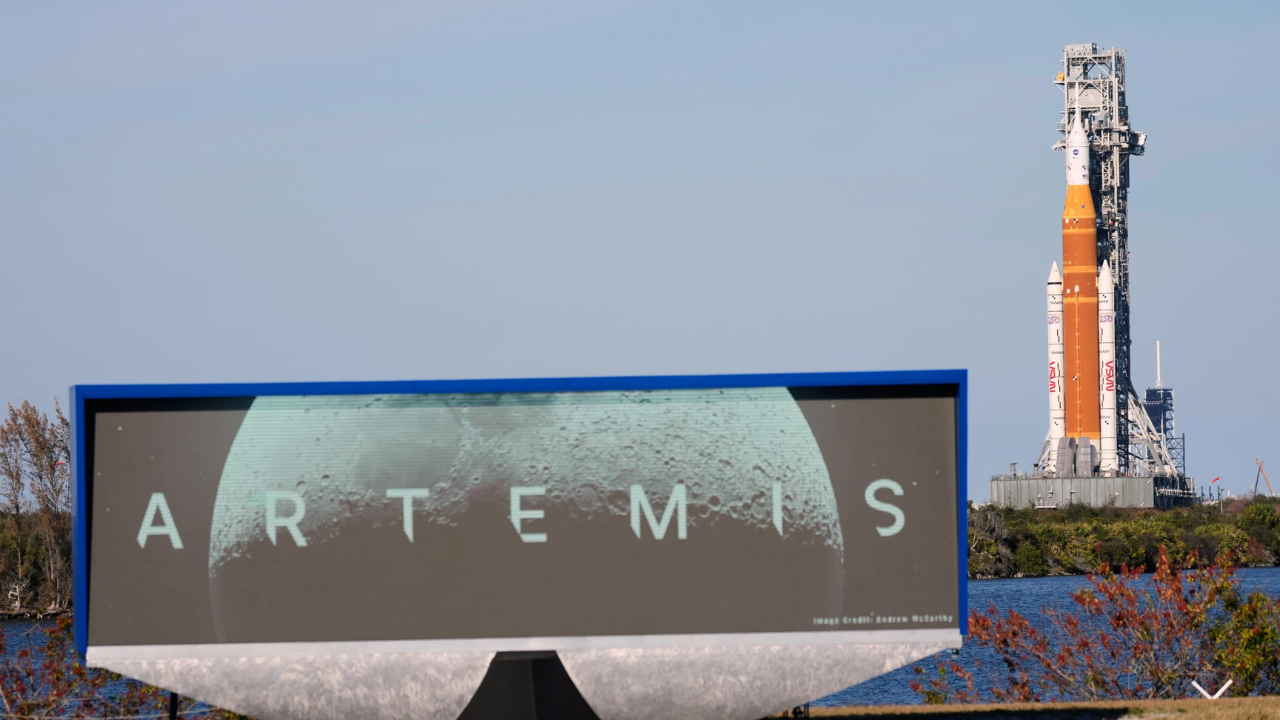
©(AP Photo/John Raoux)
Pre-reading Questions:
I will read each question. Then, please answer them.
- If you could travel to space, where would you like to go? Why?
- What do you think it would be like to see the Earth from space?
Vocabulary:
I will read the words, meanings, and sample sentences. Then, repeat after me.
- launch /LAWNCH/
[verb] – to send a rocket or spacecraft into space
The agency plans to launch a satellite next week. - mission /MISH-uhn/
[noun] – an important task that people are given to do
The astronauts trained for a difficult mission in space. - repair /ri-PAIR/
[verb] – to fix something that is broken or damaged
Engineers repair machines before they are used again. - risk /risk/
[noun] – the possibility that something bad may happen
Traveling to space always involves some risk. - develop /dih-VEL-uhp/
[verb] – to grow or change into a more advanced form
Scientists develop new tools for space research.
Article Reading:
Please read the whole article. Then, I will check your pronunciation and intonation.
NASA announced in March 2026 that the large moon rocket for the Artemis II mission is ready for another launch attempt after several technical problems were fixed. The 322-foot Space Launch System will move from the assembly building to the launch pad at Kennedy Space Center in Florida next week. NASA hopes to launch the rocket as early as April 1. The mission will send four astronauts on a trip around the moon, the first crewed lunar flight in more than fifty years. Earlier plans were delayed when hydrogen fuel leaks and other technical issues were discovered. Engineers worked carefully to repair the problems, including a helium flow issue that forced the rocket to return to the assembly building for additional checks.
NASA officials explained that Artemis II is still an important test flight and carries some risk. The Space Launch System has flown only once before without astronauts, so experts say more experience is needed to fully understand the rocket’s reliability. NASA administrator Jared Isaacman recently announced changes to the Artemis program to help speed up progress. The agency plans an additional practice flight around Earth before future moon landings. Private companies working with NASA are also trying to develop lunar landers for upcoming missions. Scientists hope these efforts will help prepare astronauts for safe landings near the moon’s south pole later in the decade.
NASA officials explained that Artemis II is still an important test flight and carries some risk. The Space Launch System has flown only once before without astronauts, so experts say more experience is needed to fully understand the rocket’s reliability. NASA administrator Jared Isaacman recently announced changes to the Artemis program to help speed up progress. The agency plans an additional practice flight around Earth before future moon landings. Private companies working with NASA are also trying to develop lunar landers for upcoming missions. Scientists hope these efforts will help prepare astronauts for safe landings near the moon’s south pole later in the decade.
Comprehension Questions:
I will read each question. Then, please answer them based on the article.
- What rocket will carry astronauts for the Artemis II mission?
- Where will the rocket launch from?
- How many astronauts will travel on the Artemis II mission?
- Why was the launch delayed earlier in the year?
- What problem forced the rocket back to the assembly building?
Discussion Questions:
I will read each question. Then, please answer them.
- Have you ever watched a live rocket launch? If so, what did you think about it? If not, would you like to see one someday?
- Have you ever learned about astronauts in school? If so, what surprised you the most? If not, what would you like to know about their work?
- Do you agree that space exploration is important for the future?
- What challenges do astronauts face when traveling to space?
- Why do large scientific missions often take many years to prepare?