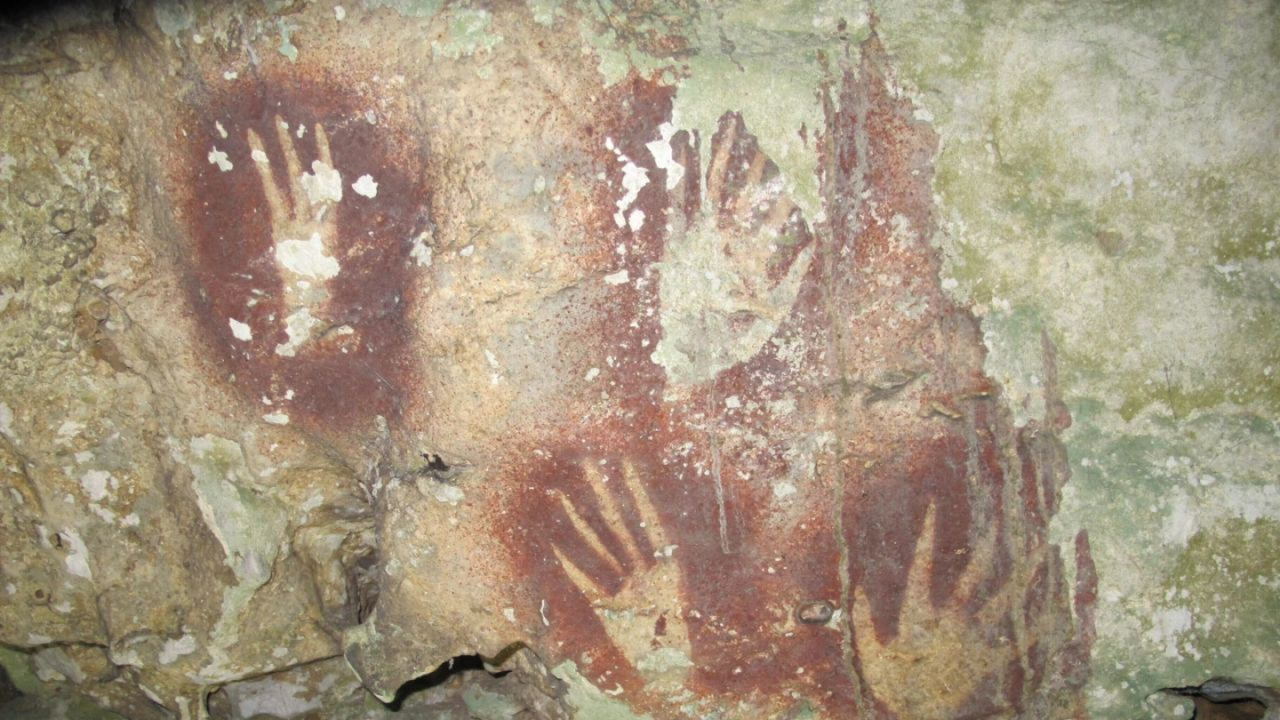
©(Ahdi Agus Oktaviana/Maxime Aubert via AP)
Pre-reading Questions:
I will read each question. Then, please answer them.
- Where do people usually draw or paint today?
- If you lived a long time ago, what would you like to draw?
Vocabulary:
I will read the words, meanings, and sample sentences. Then, repeat after me.
- outline /OUT-lahyn/
[noun] – a line that shows the shape of an object
The teacher drew an outline of a map on the board. - edge /ej/
[noun] – the outer line or side of something
The glass has a sharp edge on one side. - creativity /kree-ey-TIV-i-tee/
[noun] – the ability to make new ideas or art
The child used creativity to build a new toy. - figure /FIG-yer/
[noun] – the shape of a person or animal
A small figure was drawn in the corner of the paper. - contain /kuhn-TEYN/
[verb] – to have something inside
The box may contain old letters from the past.
Article Reading:
Please read the whole article. Then, I will check your pronunciation and intonation.
Handprints discovered on cave walls in a remote area of Indonesia may be the oldest known examples of rock art ever studied, with an estimated age of at least 67,800 years. Indonesian and Australian researchers reported the discovery on the island of Sulawesi, where tan-colored outlines were found inside limestone caves. Scientists said the images were created by placing hands against the wall and blowing pigment around the edges. Some fingertips were carefully shaped, showing planned design rather than simple marks. To measure age, researchers studied mineral layers that formed on top of the artwork. The results confirmed that the paintings were made much earlier than other known cave art. Experts said the finding is important for understanding the early history of human creativity.
Researchers explained that the artwork suggests the island supported an artistic culture long before written records existed. The study was published in an international scientific journal and raised questions about the artists. The prints may have been made by Denisovans or by early modern humans traveling through Southeast Asia. Scientists said the careful method shows planning and skill and may change ideas about early human behavior. Other drawings found nearby, including animals and human figures, were dated to later periods, showing that art traditions continued for thousands of years. Researchers believe nearby islands may contain older artwork. Future studies may help explain how early creativity developed and spread across human societies.
Researchers explained that the artwork suggests the island supported an artistic culture long before written records existed. The study was published in an international scientific journal and raised questions about the artists. The prints may have been made by Denisovans or by early modern humans traveling through Southeast Asia. Scientists said the careful method shows planning and skill and may change ideas about early human behavior. Other drawings found nearby, including animals and human figures, were dated to later periods, showing that art traditions continued for thousands of years. Researchers believe nearby islands may contain older artwork. Future studies may help explain how early creativity developed and spread across human societies.
Comprehension Questions:
I will read each question. Then, please answer them based on the article.
- What was discovered on cave walls in Indonesia?
- How old may the handprints be?
- On which island were the outlines found?
- How did scientists say the images were created?
- What did researchers study to measure the age of the artwork?
Discussion Questions:
I will read each question. Then, please answer them.
- Have you ever visited a cave or a very old place? If so, what did you see there? If not, what kind of old place would you like to visit?
- Have you ever made pictures with your hands or fingers? If so, what did you make? If not, what picture would you like to try to make?
- Do you agree that old paintings are important for learning about people in the past?
- Why is it important to know how old the paintings are?
- How can learning about the past help us today?